

To meet the increasing AI demands for computing power, the competition is intensifying among the Companies to Beat in the AI semiconductor vendor race, according to Gartner, Inc., a business and technology insights company.
In the Company to Beat insights from Gartner, analysts have identified market-defining AI leaders across more than 40 categories to pinpoint the companies to beat. These companies are setting today’s benchmark for excellence.
In the fast moving and evolving AI vendor race, the Company to Beat is determined by a methodology based on, but not limited to, six key criteria that differentiate top vendors in the space: technical capabilities, customer implementations, potential customer base, business model, key partnerships, and the broader surrounding ecosystem.
“In the AI vendor race, semiconductor front-runners have massive opportunities to capitalize on the shift toward next-generation infrastructure and the unprecedented demand for compute cycles,” said Kevin Knox, Practice Vice President at Gartner. “While current frontrunners are outpacing competition through deep technical expertise, software capabilities and ecosystem control, their status is being actively challenged by rivals capitalizing on supply chain diversification, the adoption of open industry standards, and the growing demand for efficient, inference-optimized architectures.”
The Companies to Beat in highlighted AI semiconductor segments include:
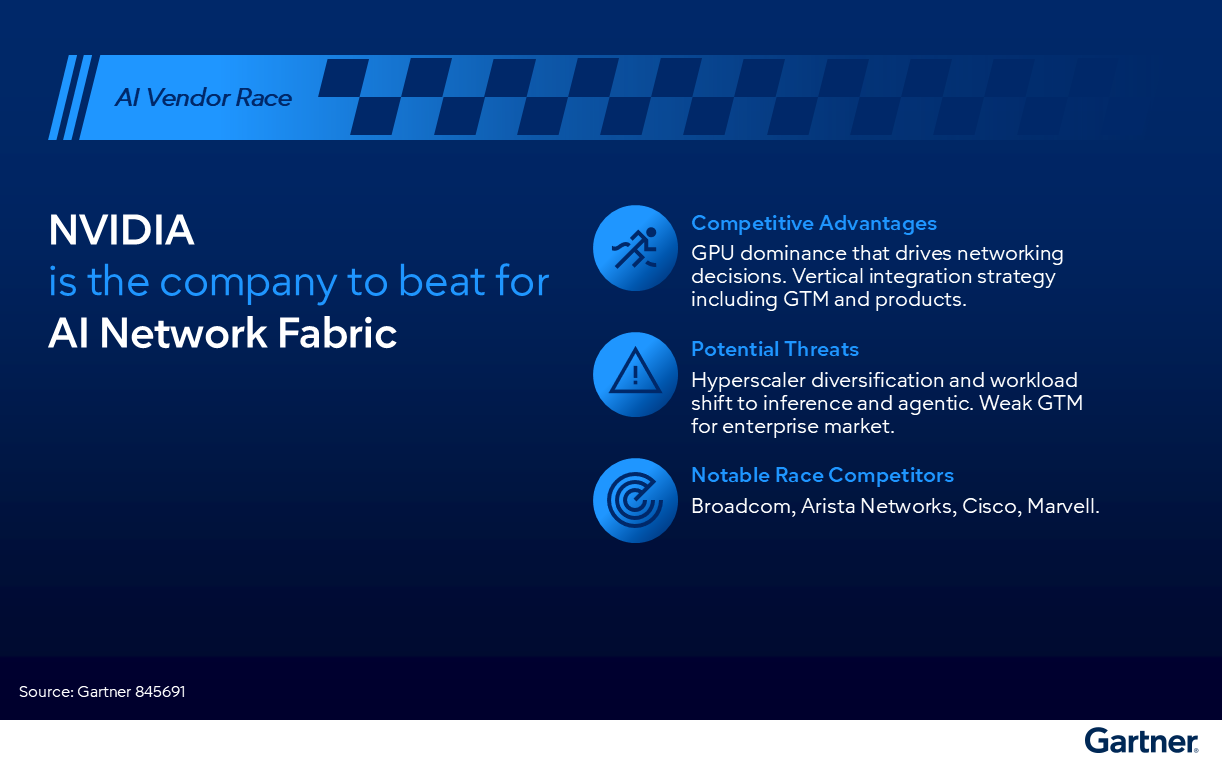
NVIDIA is the Company to Beat for AI Network Fabric
Gartner analysts said that NVIDIA stands out due to its dominance in AI accelerators and broad portfolio of data center networking offerings (see Figure 1). NVIDIA’s use of proprietary protocols and features (such as SHARP, SHIELD, NVHS and NVLink) delivers high performance and reliability, reinforcing its dominance in both scale-out and scale-up networking for AI clusters.
However, the ongoing demand shift from training to inference and agentic use cases can fundamentally change the AI vendor landscape and impact NVIDIA’s front-runner status. Big customers, such as hyperscalers, are rapidly moving toward open, Ethernet-based alternatives, as NVIDIA’s products and go-to-market (GTM) strategy lack alignment with the mainstream enterprise market.
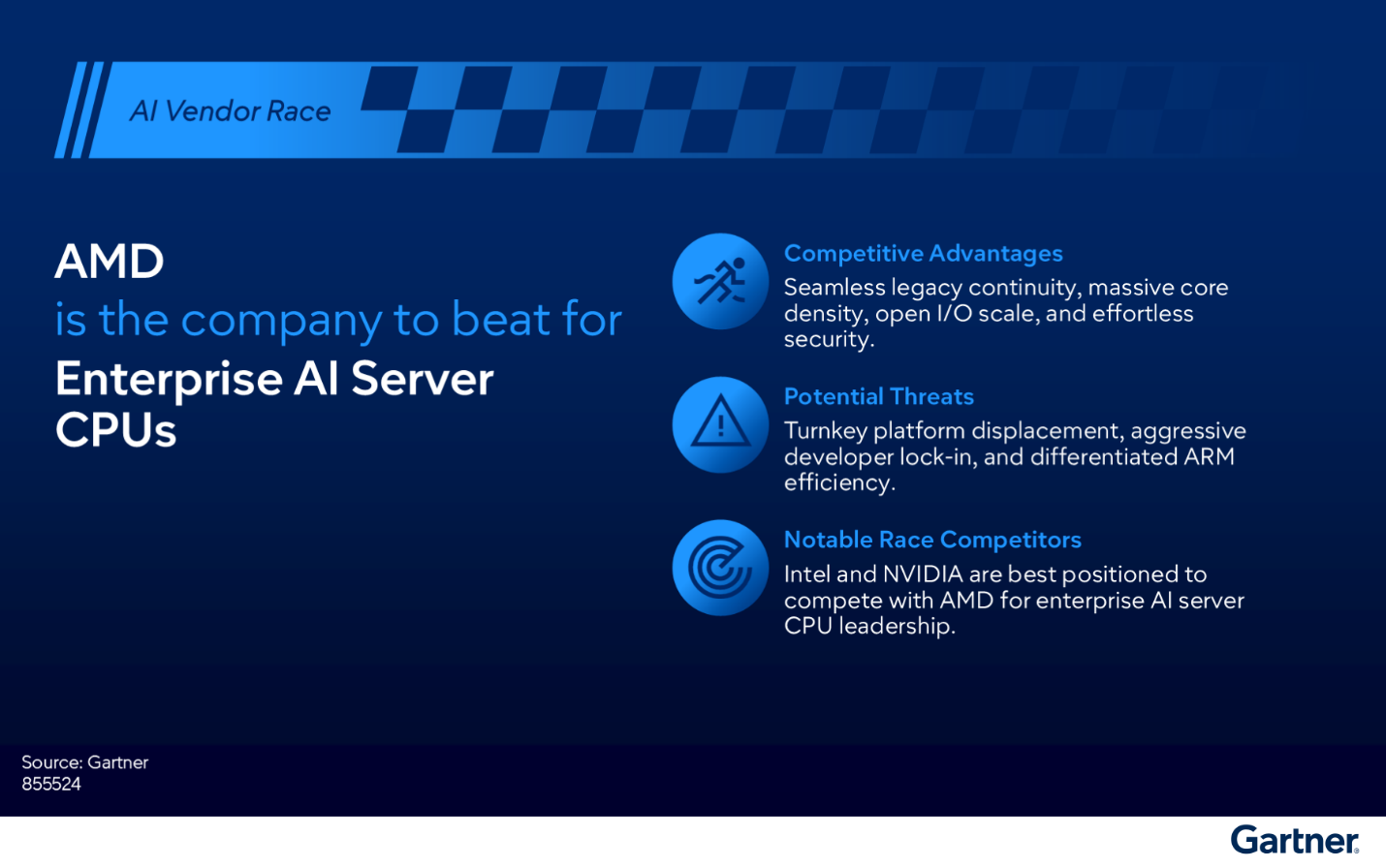
AMD is the Company to Beat for Enterprise AI Server CPUs
AMD’s alignment with agentic AI orchestration, its I/O bandwidth, and its server consolidation capabilities make it the company to beat for enterprise AI server CPUs (see Figure 2). The company is the front-runner with consistent roadmap execution and broad ecosystem support, ensuring legacy compatibility and OEM alignment.
The enterprise AI server CPU market, which remains highly dynamic and subject to rapid change, is entering a phase of accelerated competition as organizations stabilize procurement cycles around dense, power-constrained rack architectures. AMD faces challenges in the market from competitors’ integrated stacks, growing software lock-in and performance-per-watt benefits in ARM-based CPU solutions.
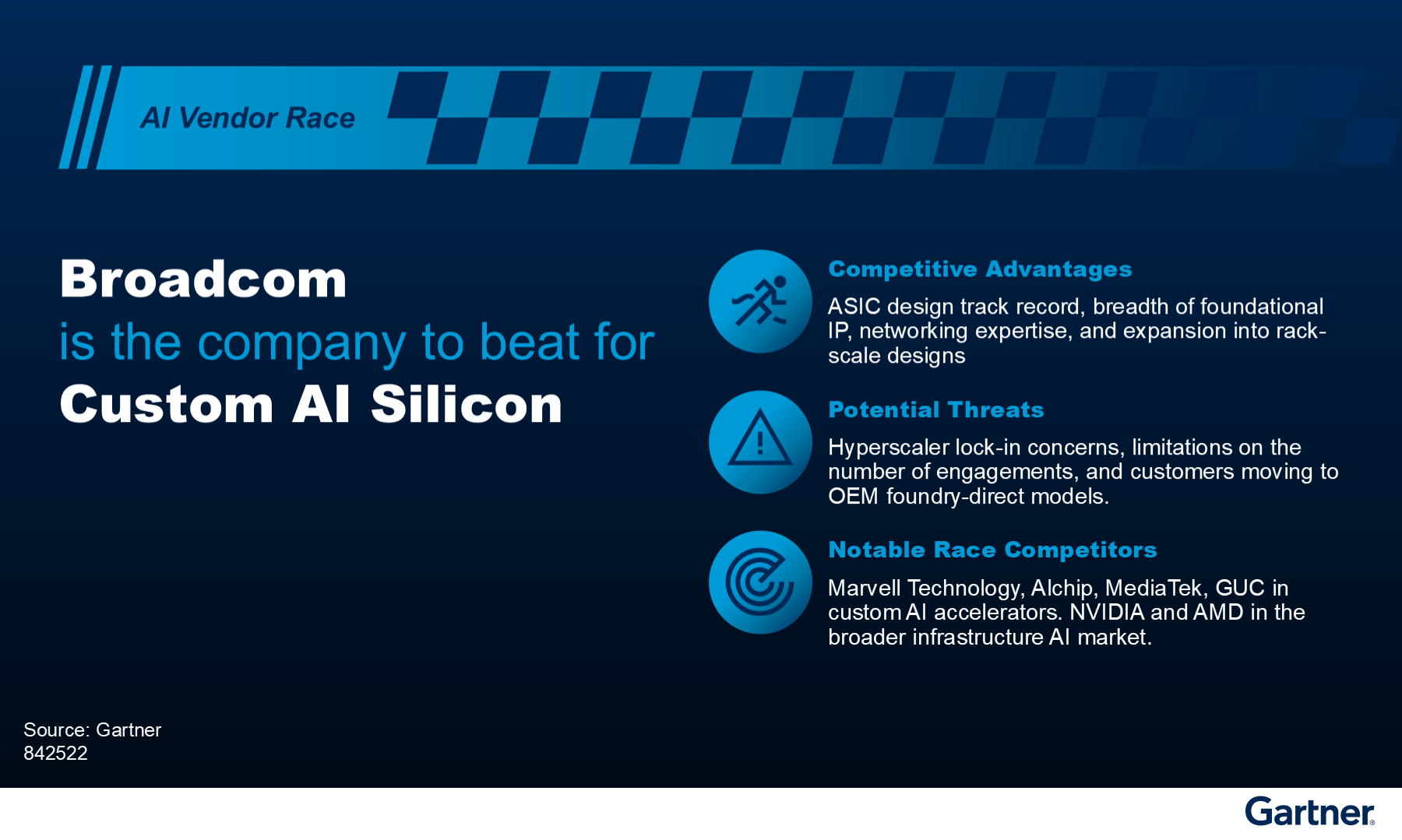
Broadcom is the Company to Beat for Custom AI Silicon
Broadcom’s capabilities in ASIC design, networking, and foundational IP make it the company to beat in custom AI silicon. It is the front-runner in the foundational IP and custom AI accelerator design, using leading-edge process nodes, advanced packaging, SerDes, memory, and die-to-die interconnect.
Competitors who improve weaknesses in their IP portfolio, offer flexible engagements, and support system-level designs can close the gap. To better compete, tech provider executives should also address AI portfolio shortcomings by collaborating with third-party IP suppliers, open industry consortiums, or acquire the necessary technology.
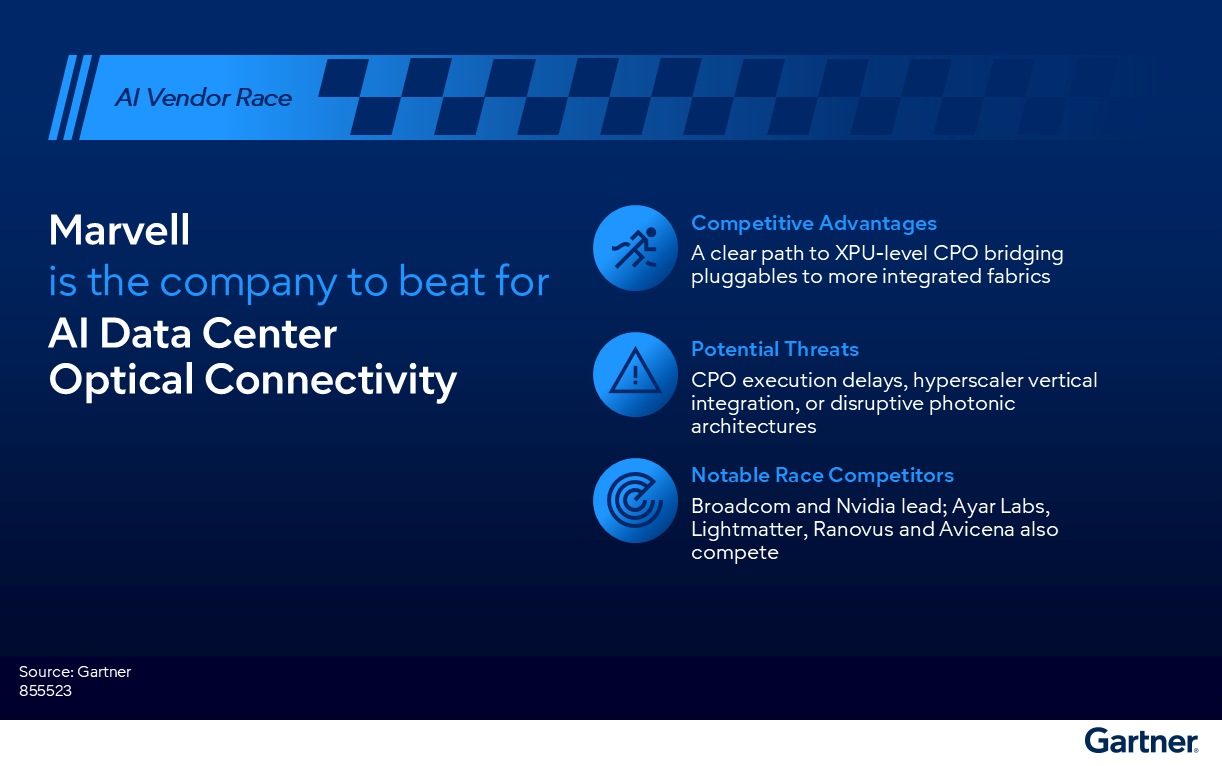
Marvell is the Company to Beat in AI Data Center Optical Connectivity
Marvell’s unique end-to-end exposure across digital signal processor (DSP)-based pluggables, analog optical components, emerging linear receive optics (LRO) platforms and plans for scale-up co-packaged optics (CPO) make it the company to beat in AI data center optical connectivity (see Figure 4). The company stands out in optical DSP and analog components, providing a durable revenue base and continued influence as architectures evolve beyond pluggables.
Competitors must target integration or deliver differentiated architectures to close the gap. Marvell’s success could be challenged by CPO execution risk, hyperscaler vertical integration and alternative photonic architectures that shift control away from merchant suppliers.
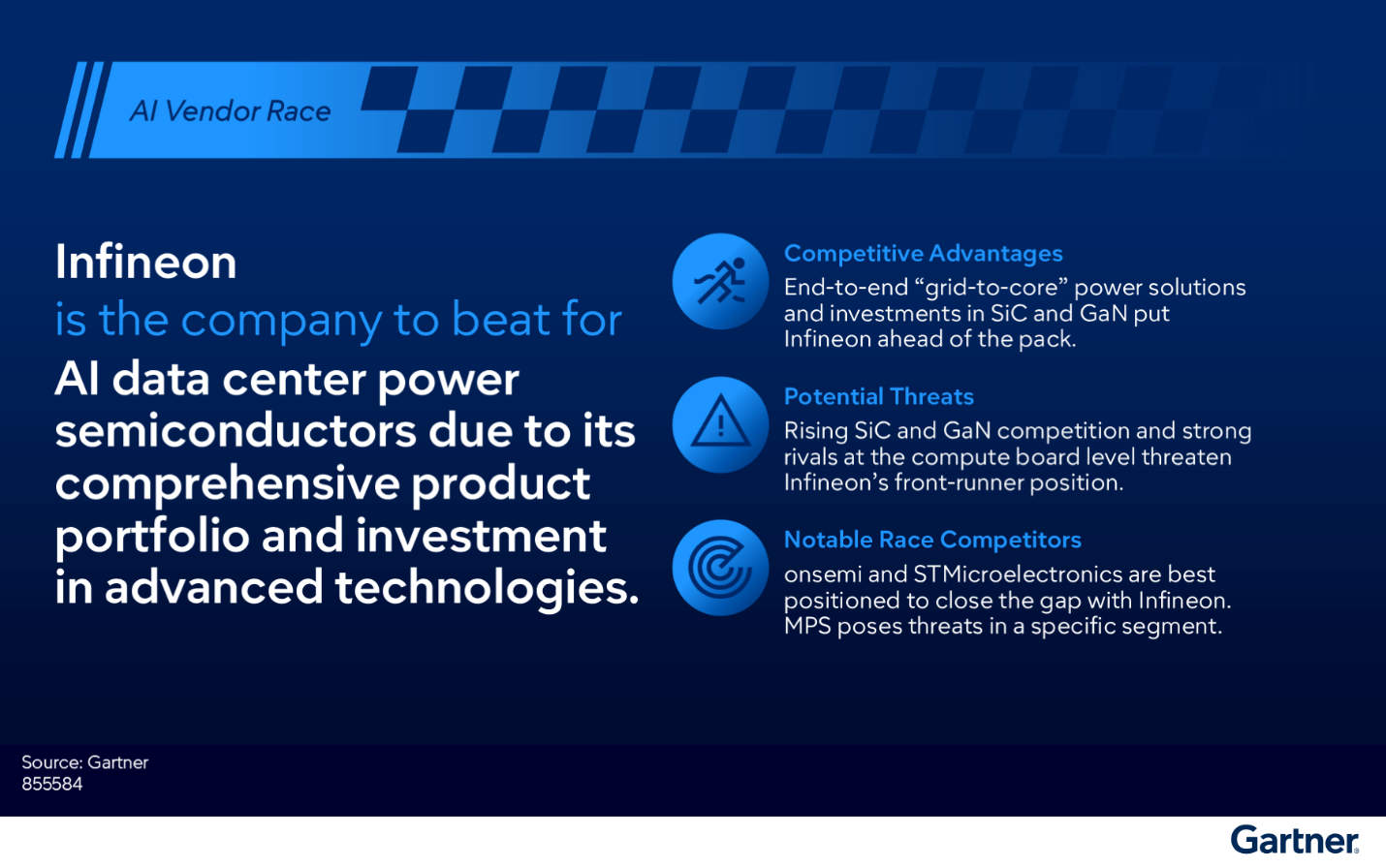
Infineon is the Company to Beat in AI Data Center Power Semiconductors
Infineon is the company to beat in AI data center power semiconductors (see Figure 5) as it holds an early advantage in AI data center power systems due to its comprehensive product portfolio, spanning silicon (Si), silicon carbide (SiC) and gallium nitride (GaN), enabling end-to-end power solutions from the utility grid all the way to the processor core, supported by its strong in-house manufacturing capabilities.
Infineon’s front-runner position in the AI data center power semiconductors race is challenged by intensifying SiC and GaN competition and strong rivals at the compute board level for the final step of power delivery. Competitors can close the gap by expanding partnerships, entering the 800VDC ecosystem and developing forward-looking roadmaps on both discrete and integrated power solutions.
Additional Insights Available
Gartner clients can explore Gartner’s analysis of current frontrunners in the AI Vendor Races in more than 40 segments, including their advantages and vulnerabilities, in the Companies to Beat site here.
Assessment is performed by teams of expert analysts who collaborate to establish Gartner’s opinions. Analysts consider a variety of data and information sources including, but not limited to, interactions with end users and vendors, peer review, public data, Gartner proprietary data and analysts’ own explorations on the market. As the race evolves, Gartner’s assessment, insights, and advice about how to compete in the market will evolve too, and different vendors can become the Company to Beat.
Non-clients can find more information here.