
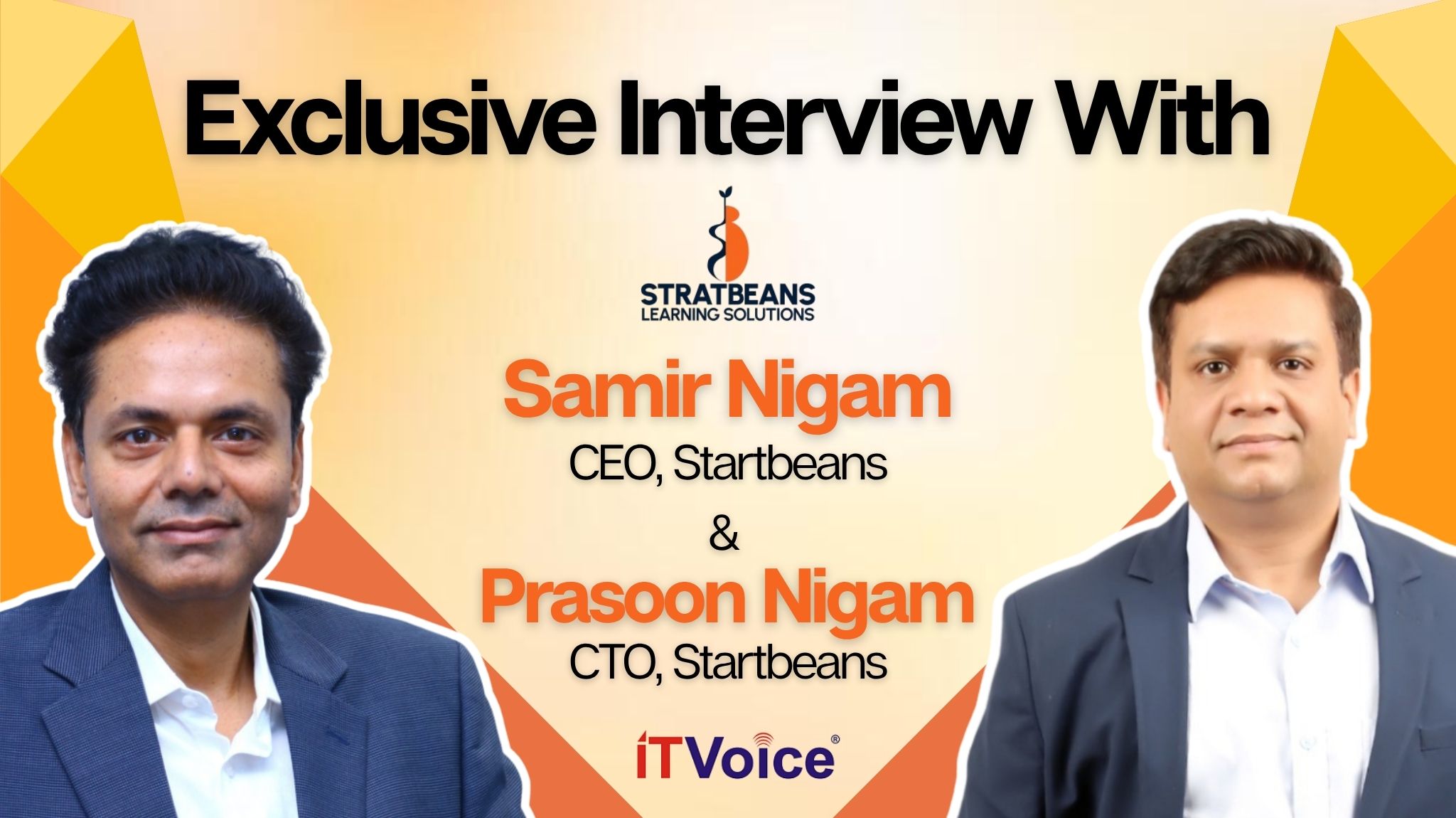
In an exclusive interaction with IT Voice, leadership voices from Stratbeans share a comprehensive perspective on how artificial intelligence is transforming the Learning & Development (L&D) landscape.
Samir Nigam, CEO, highlights the strategic shift from content-driven learning to capability-focused outcomes, while Prasoon Nigam, CTO, dives into how AI is accelerating content creation, enhancing creativity, and enabling scalable, future-ready learning ecosystems.
Together, they outline a clear roadmap for organizations navigating the AI era.
Interaction with Mr. Samir Nigam
IT Voice- What is the biggest shift happening in corporate learning today?
Samir Nigam- Corporate learning has traditionally revolved around content creation, delivery, and completion tracking. However, this model is undergoing a major transformation.
Today, organizations are shifting their focus from content to capability—evaluating how effectively their workforce can perform in real-world scenarios. Learning is no longer just about acquiring knowledge; it is about decision-making and application.
Equally important is the evolution of measurement metrics. Instead of tracking completion rates, organizations are now focusing on business outcomes—linking learning directly to performance, productivity, and organizational impact.
IT Voice- What strategies should large enterprises adopt to scale workforce learning?
Samir Nigam- The AI era has created a real-time, always-on environment where geographical boundaries no longer matter. Learning must evolve accordingly.
Organizations need to build continuous learning ecosystems and reduce the gap between people and knowledge. With AI-powered tools and co-pilots, learning is becoming more accessible and immediate.
However, the biggest challenge lies in breaking organizational silos. Every department must align with business performance and contribute directly to outcomes such as revenue, customer experience, and agility.
A key mindset shift is essential—every team must ask:
- How am I contributing to business outcomes?
- How am I improving customer experience?
- How quickly can I adapt and respond?
IT Voice- What message would you like to give organizations starting their AI journey?
Samir Nigam- Speed matters—but so does clarity. Organizations should adopt a phased approach:
- Start with a focused function and identify quick wins
- Expand across teams and integrate functions
- Move toward complete organizational alignment
- Build continuous feedback loops to refine outcomes
Challenges will always exist, but they should be seen as opportunities to learn and improve. Capturing these challenges and feeding them back into the system creates a cycle of continuous growth.
Interaction with Mr. Prasoon Nigam
IT Voice- AI is widely associated with content creation. How is it transforming learning beyond that?
Prasoon Nigam- The most immediate impact of AI is content velocity. What used to take 6–8 weeks can now be achieved in under a week.
But the real transformation lies beyond speed. AI brings creative horsepower, enabling teams to design richer, more engaging learning experiences. It enhances visualization, simplifies complex concepts, and introduces new dimensions to instructional design.
Most importantly, AI frees up bandwidth. Teams that were previously focused on repetitive tasks can now shift toward strategic thinking and innovation.
IT Voice- How is AI helping organizations address localization challenges?
Prasoon Nigam- Localization has always been a challenge, especially in diverse markets like India.
AI significantly simplifies this by enabling rapid translation into multiple languages. While not perfect, it achieves a high level of accuracy, allowing human experts to focus on refinement instead of starting from scratch.
This makes learning more inclusive, scalable, and accessible across regions and audiences.
IT Voice- What mistakes do organizations commonly make while adopting AI?
Prasoon Nigam- The biggest mistake is adopting AI out of FOMO without fixing foundational systems.
AI is an amplifier—it enhances what already exists. If your systems are strong, it delivers powerful results. If not, it amplifies inefficiencies.
Organizations must ensure that their core systems—HRMS, LMS, and performance platforms—are well-integrated before layering AI on top.
IT Voice- What should organizations focus on from a technology perspective?
Prasoon Nigam- There are three key priorities:
- AI and Data Literacy: Equip teams to effectively use AI
- System Integration: Ensure seamless connectivity across platforms
- AI-Driven Efficiency: Use AI to accelerate content creation and unlock strategic capacity
AI is incredibly powerful—but only when implemented with the right foundation and approach.
IT Voice- Is AI replacing traditional learning methods or enhancing them?
Prasoon Nigam- AI is not a sudden disruption—it’s an evolution, much like the internet or cloud computing.
Organizations should adopt it gradually, focusing on solving real problems rather than chasing hype. A steady, structured approach will deliver far better results than rushed transformation initiatives.