

Almost every industry is now functioning with the integration of digital technology. Even the automotive retail industry is now integrating connected car technologies, electric vehicles, and the changing expectations of consumers. It has given rise to the need to continuously train the employees across all departments. It has become an increasingly challenging process for companies that still rely on the traditional methods of training. Companies can no longer function based on quarterly workshops and on-ground sessions. The retail environment is now scaling at a rapid pace, and these methods are proving to be ineffective.
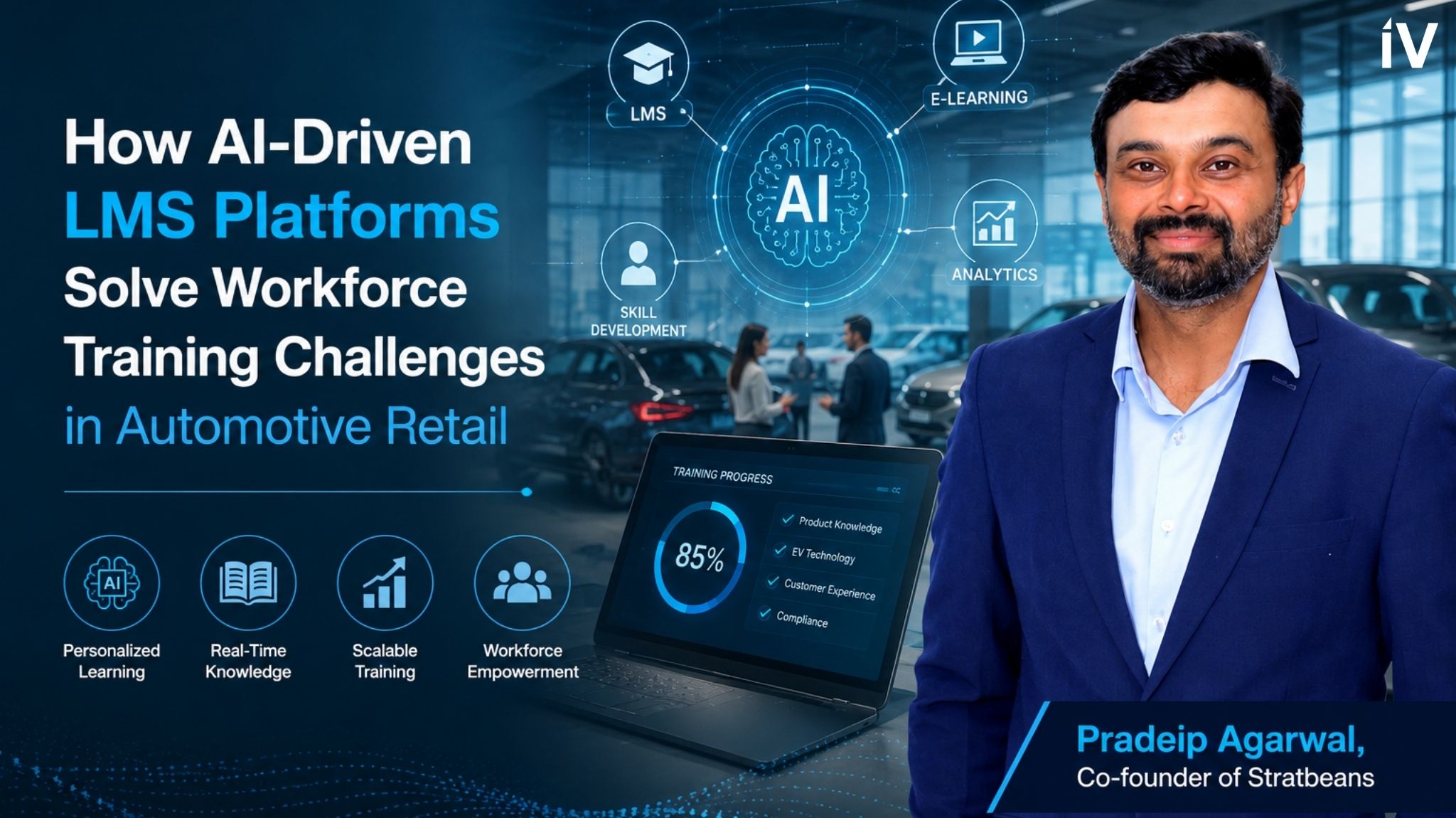
The AI-Driven Learning Management System (LMS) has emerged as a promising solution to this ongoing problem. It has transformed the working of workforce training in automotive retail. The modern technologies have now seen the inclusion of artificial intelligence, which has enabled companies to deliver a more scalable and personalised employee training program. Consequently, it has also improved the overall customer experience and the operational efficiency of the company.
According to Worldmetrics, the share of automotive companies offering online learning modules increased by 65% between 2020 and 2023, highlighting the shift toward digital training platforms.
Automotive Retail and The Growing Challenges in Workforce Training
The challenges that have been persistent in the automotive retail sector in terms of workforce training have directly impacted customer satisfaction and sales performance. As the products are now subject to constant innovation and redesign, it is proving challenging for the companies to constantly upskill their employees. They have updates in terms of software, features, and the digital dashboards. The advanced driver-assistance systems can also be difficult to understand for some of the employees.
The turnover of the workforce is another challenge that is being faced by this industry. In the sales roles, the automotive industry remains prone to employee attrition. If the companies choose to train their employees through the traditional models, it can prove to be an expensive and time-consuming process. It also becomes difficult to maintain consistency across the companies. It might be based in various locations, and it becomes important to have the same training programmes across all locations.
According to research, automotive dealerships continue to struggle with employee retention. Some dealership workforce reports estimate an 80% first-year attrition rate for automotive sales representatives.
The traditional models of training also lack a certain degree of personalisation and consume a lot of time. If a given set of employees receives the same training, there is a higher chance of inefficiencies and lower engagement rates. The AI-powered platforms are able to help companies overcome these issues and make their training programmes more data-driven, smart, and adaptive.
Personalised Learning Curve for Every Employee
These advanced platforms can produce programmes which are directed towards the maximum improvement of employees. They are able to analyse the employee performance, training history, and job role. They accordingly deliver a training programme for the given employee. Employees are not forced to complete a generic course. The programmes are given based on their performance metrics and their individual skill gaps. This helps improve both their engagement and their learning efficiency. It also enables the employees to learn at their own pace. Some employees can focus more on their problem areas and get a deeper understanding, while others can move ahead in a more speedy fashion.
Real-Time Updates Regarding Product Knowledge
As the automotive industry continuously improves in terms of vehicles, software updates, and features, it becomes important to train the employees in every aspect. The AI-based platforms are able to provide them with the latest updates across the dealership networks. The training modules are provided to the employees via their smartphones, dashboards, or online portals.
In this way, the employees always remain updated regarding the latest products, and they are able to assist the customers in the best possible manner. Currently, it has become imperative to have knowledge about the recent developments because of the rapidly evolving government restrictions and EV technology.
Industry experts note that electric vehicles require different technical skills because EVs involve fewer mechanical parts and greater dependence on software, electronics, and battery systems.
Scaling of The Industry With AI-Based Learning Platforms
It can become difficult to scale automotive industries which are based in different regions or cities. It can become logistically complex and expensive to have in-person training for thousands of employees who are working for the company. These AI-powered platforms help train the employees most efficiently. The employees can access their learning modules at any given time with the help of their smartphones or tablets. Some employees might not find the time to attend a classroom during their working hours, and AI-based learning proves to be a viable alternative for such employees.
As these systems work through a centralized dashboard, they are able to maintain the employee progress, completion rates, and training completion records in a single place. Subsequently, the workforce becomes better prepared to handle tough situations and becomes an asset to their respective organisation.
Future of AI-Based Platforms In The Automotive Industry
As the world is constantly being shaped by developments in technology, it has become crucial to integrate artificial intelligence into our daily lives. The automotive industry is no exception, and the employees need to have adequate training in the required areas. Companies are now able to transition from their age-old models to the new intelligent systems and make the most of their capabilities.
As the training programmes become more personalised, companies are able to improve the product knowledge and automate the assessments. As a result, learning has become more accessible across the dealership networks. Even the workforce has now become more informed, skilled, and customer-focused.
The sales performance is continuously influenced by the technical expertise and the customer experience. Therefore, it has become crucial to integrate intelligent systems which can provide a competitive advantage to the current workforce.