

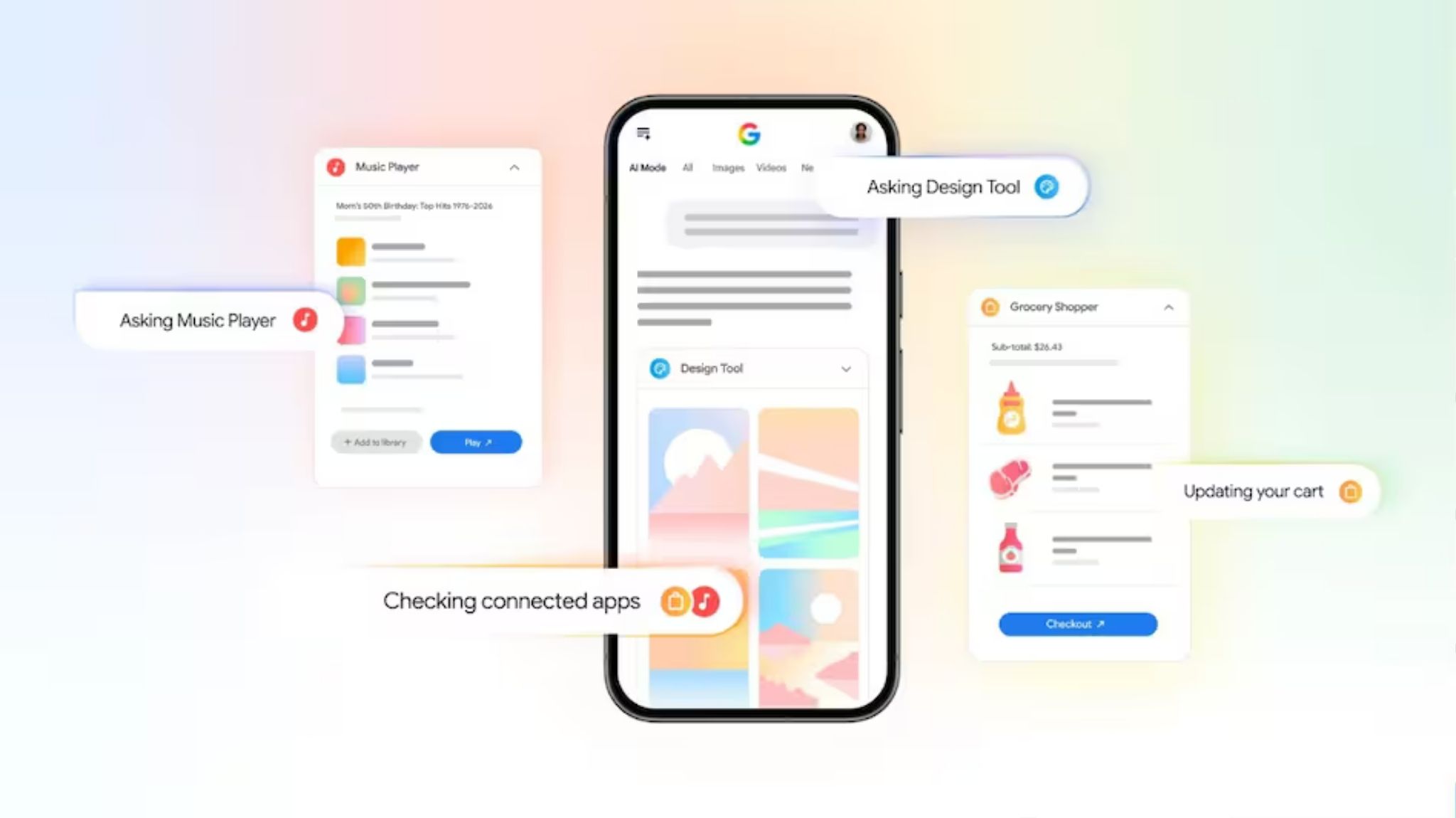
Google is fundamentally altering the way users interact with the internet by introducing third-party application integrations directly into its Gemini-powered Search AI Mode. The initial rollout, currently live for users in the United States, signals a massive structural evolution for Google Search—moving it from a passive directory of links to an active, task-oriented ecosystem capable of executing complex workflows.
Seamless Task Execution Across Major Platforms
At launch, the integration features a powerful trio of ecosystem partners: Instacart, Canva, and YouTube Music. Rather than merely answering user queries with text summaries or traditional web links, Google’s AI Search can now securely bridge the gap between intent and action, enabling users to complete digital chores without ever leaving the search interface.
The practical applications of this integration change everyday workflows:
-
Instacart: A user searching for a specific recipe can now instruct the AI to instantly convert that ingredient list into an active grocery cart order, directly pushing the items to their Instacart account.
-
Canva: Content creators seeking design inspiration can ask for specific visual layouts, prompting the AI to retrieve and pull customized Canva templates directly into the search module.
-
YouTube Music: Users searching for artists, genres, or moods can direct the AI to compile, curate, and automatically save new music playlists directly to their streaming libraries.
A Strategic Pivot Toward “Agentic” Search
This upgrade represents Google’s competitive answer to the broader industry shift toward “agentic” AI—software capable of autonomously performing actions on behalf of a user. By allowing external platforms to plug directly into Search AI Mode, Google is establishing its interface as a centralized operating system for the web.
For users, this reduces friction by eliminating the need to bounce between tabs, copy-paste data, and log into multiple independent platforms. For the tech industry, the update sets a new benchmark for automated browsing, proving that the future of search is no longer about finding information, but getting things done.