



India’s electronics industry has grown rapidly over the past decade, but it has also revealed a structural gap. Much of the sector still depends heavily on imported semiconductors and high-value electronic components. The global chip shortages during the pandemic years made this vulnerability difficult to ignore. Production delays across industries such as automobiles, consumer electronics and appliances demonstrated how deeply India relied on global supply chains for critical technology inputs.
This reality has accelerated the country’s push to develop domestic semiconductor capability. The launch of the India Semiconductor Mission (ISM) marks a strategic shift from being primarily an electronics assembly hub to building core technology infrastructure within the country.
Building Domestic Semiconductor Capability
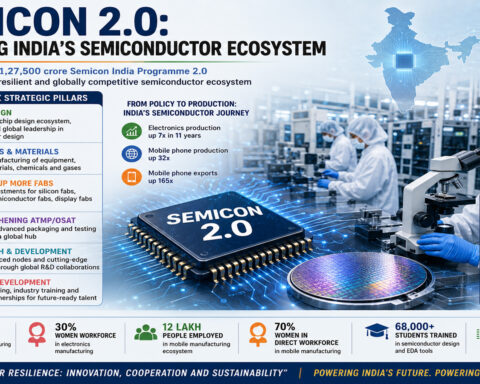
India’s semiconductor initiative is anchored by a large financial commitment from the government. In 2021, the government approved a ₹76,000 crore incentive program to develop a semiconductor and display manufacturing ecosystem in India, aimed at attracting global chipmakers and encouraging domestic investment in fabrication, packaging and design. The program seeks to bring in leading semiconductor fabs, OSAT and ATMP facilities while strengthening the broader supply chain.
The focus is not limited to wafer fabrication plants alone. Policymakers are attempting to build an integrated semiconductor ecosystem that includes chip design, compound semiconductors, display manufacturing and advanced packaging capabilities. This holistic approach recognises that a resilient semiconductor industry requires a full value chain rather than isolated investments.
A Boost for Electronics and Consumer Durables
For India’s electronics and consumer durables industry, local semiconductor availability could be transformative. Products such as televisions, smartphones, home appliances and smart devices rely heavily on integrated circuits and controllers. When global chip shortages emerged in recent years, manufacturers faced extended lead times and price volatility.
Domestic semiconductor capacity can help stabilise component supply, reduce logistics dependencies and improve pricing predictability. As India aims to strengthen its position as a global electronics manufacturing hub, chip availability within the country becomes a critical advantage.
According to government data, India’s electronics manufacturing output has already crossed USD 100 billion in recent years, reflecting the rapid expansion of the sector. Building semiconductor capabilities is the next logical step in strengthening this industrial base.
Policy Support and Supply Chain Realignment
Production Linked Incentive programs have also played a key role in encouraging component localisation across the electronics sector. These schemes reward manufacturers for incremental production and have already attracted investments in mobile phones, white goods and electronic components.
At the same time, global semiconductor supply chains are undergoing a period of realignment. Countries are actively diversifying manufacturing bases to reduce geopolitical risk and supply concentration. In this environment, India is positioning itself as a trusted manufacturing partner supported by policy incentives, engineering talent and a large domestic market.
Talent and Design Strength
India already holds a strong position in semiconductor design. A significant share of the world’s chip design talent works out of India, contributing to global semiconductor companies across design, verification and R&D functions. This design-led advantage offers a unique opportunity. With the right manufacturing ecosystem, India can move beyond design services to become a more integrated semiconductor player.
Semiconductor fabs and packaging facilities also create high-skill employment across engineering, materials science and advanced manufacturing. These facilities will require thousands of specialised professionals, strengthening India’s technical workforce and research ecosystem.
State-Level Support and Infrastructure
Several states are now actively competing to attract semiconductor investments. Gujarat, Tamil Nadu and other states have announced policies offering land, power infrastructure and fiscal incentives for semiconductor projects. This federal competition is helping accelerate project pipelines while creating specialised manufacturing clusters.
Semiconductor fabrication remains capital intensive and requires substantial water, energy and infrastructure planning. As projects move forward, sustainability considerations will become increasingly important. Efficient water recycling, renewable energy integration and responsible resource management will play a key role in ensuring long-term viability.
A Long-Term Strategic Investment
Building a semiconductor ecosystem is not a short-term undertaking. Fab projects require billions of dollars in investment and years of execution. However, the long-term benefits extend far beyond chip production. Domestic semiconductor capability supports innovation across emerging technologies such as artificial intelligence, electric vehicles, 5G networks, defence electronics and industrial automation.
It can also help reduce India’s electronics import bill. The country’s electronics imports remain among its largest trade components, and strengthening domestic production will gradually narrow that gap.
India’s Semiconductor Mission therefore represents more than an industrial policy initiative. It reflects a strategic shift in how the country approaches technology manufacturing. By investing in semiconductors today, India is laying the foundation for a more resilient and competitive electronics ecosystem in the years ahead.