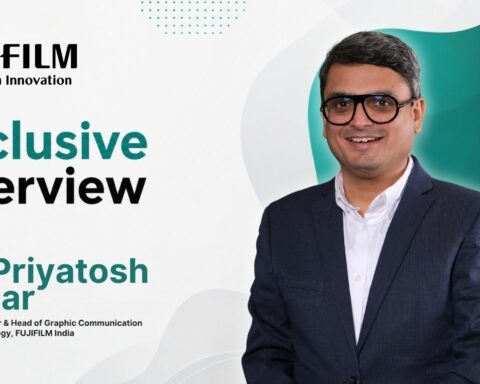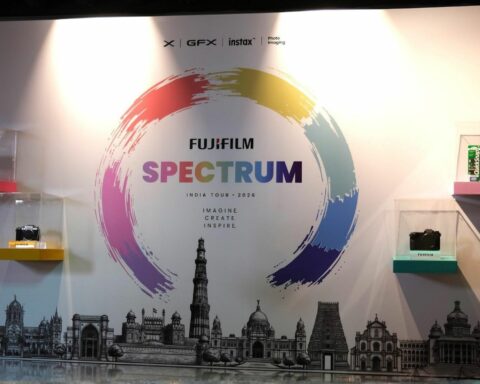
In this exclusive interview, Mr. Priyatosh Kumar highlights how FUJIFILM India is empowering SMEs and enterprises with digital-first printing, hybrid devices, and specialty applications. He also shares insights on the future of India’s production print market, the growing role of AI, automation, and sustainability, and FUJIFILM’s roadmap to lead the shift toward agile, eco-friendly, and high-value print solutions.
IT Voice- How do you see the light production and entry-level production print segments evolving in India, especially with SMEs and mid-sized print businesses adopting digital-first approaches?
Priyatosh Kumar- India’s light production and entry-level production print segments are at an inflection point, largely driven by growth of the economy, reduced barriers of equipment investment, imporved quality and stability of digital devices aided by the digital-first mindset of SMEs and mid-sized print businesses. Today’s market realities like shorter run lengths, faster turnaround demands, and the growing need for personalization are shifting the equation decisively towards digital. SMEs, in particular, are embracing digital presses as they allow for on-demand, variable data printing with minimal wastage, while also reducing inventory and working capital pressures.
There is a business model shift. Print service providers in Tier 2 and Tier 3 cities, for instance, are increasingly investing in light production systems to cater to local demand for marketing collateral, photo applications, packaging prototypes, and personalized content. As the Indian economy grows more service-led and experience-driven, these segments will continue to expand, positioning digital presses as indispensable tools for SMEs that want to remain agile, competitive, and future-ready.
IT Voice- What role do hybrid devices that combine professional print quality with office productivity play in bridging the gap between commercial print shops and corporate in-house printing needs?
Priyatosh Kumar- Hybrid devices are becoming an important bridge between traditional print shops and corporate in-house printing needs. Many organizations today are looking to bring certain print functions closer to their teams, whether for marketing materials, training modules, or short-run promotional campaigns, without having to rely entirely on external vendors. At the same time, they cannot compromise on quality, consistency, or finishing capabilities, which is where hybrid multifunctional devices come into play.
These systems provide enterprises with the flexibility to manage both day-to-day office documentation and high-quality print jobs within the same ecosystem, making them cost-effective and operationally efficient. This convergence also opens up new revenue streams for print service providers by enabling them to serve clients with faster, on-demand requirements. In a market like India, where agility and cost optimization are paramount, hybrid devices are reshaping the way businesses think about print – moving it from a service to a strategic in-house capability while still complementing the role of commercial print shops.
IT Voice- Why are media versatility and specialty toners increasingly in demand, and how are they fueling a resurgence in creative, high-impact print applications across industries like packaging, retail, and marketing?
Priyatosh Kumar- Media versatility and specialty toners are becoming critical differentiators in today’s print landscape because brands and businesses want their communication to stand out in an increasingly crowded and digital-first world. The ability to print on diverse substrates ranging from textured papers and metallic boards to clear labels opens up new creative avenues for applications in packaging, retail displays, and high-value marketing collateral. This flexibility is particularly relevant where SMEs and brands alike are seeking cost-effective but impactful ways to capture consumer attention in highly competitive markets.
Specialty toners such as white, silver, and pink are further adding to this resurgence by enabling effects that go beyond the traditional CMYK palette. These enhancements allow printers to achieve richer colorgamuts, simulate metallic finishes, or deliver vibrant RGB-like tones – capabilities that were previously either too expensive or restricted to niche technologies. As a result, creative agencies, packaging converters, and marketers now view digital print as a medium of innovation.
IT Voice- From your experience, what are the key differences between global production print trends and India-specific market demands, and where do you see the Indian market heading in the next 2-3 years?
Priyatosh Kumar- Globally, production print markets are more mature with a steady focus on automation, sustainability, and high-value applications such as personalized packaging or short-run publishing. In India, however, the story is slightly different. Our market is still in a high-growth phase where SMEs and mid-sized businesses are embracing digital print as a strategic tool for agility, quick turnaround, and cost efficiency. While the West is often about enhancing efficiency in an already digitized environment, in India the shift is still about digitization itself – bridging the gap between conventional offset and on-demand, high-quality digital print.
Over the next 2-3 years, I see the Indian market accelerating its adoption of hybrid printing ecosystems where digital complements offset for shorter runs, personalization, and specialty applications. Sectors such as retail, education, e-commerce packaging, and even corporate in-house print will fuel this demand. At the same time, there will be an increased emphasis on sustainability, media versatility, and automation-driven efficiency, mirroring global trends but at a much faster pace of adoption. In essence, India’s production print market is leapfrogging in ways that will make it one of the most dynamic and opportunity-rich regions in the world for digital printing solutions.
IT Voice- How is FUJIFILM enabling businesses in India to embrace digital transformation through its graphic communication and device technology portfolio?
Priyatosh Kumar- At FUJIFILM India, our focus is on enabling businesses to unlock new growth opportunities by embracing digital transformation in printing. Through our Revoria Press series and Jet Press inkjet solutions, we bring technologies that combine professional-grade output with automation, sustainability, and cost-efficiency, making high-quality digital printing more accessible to SMEs, commercial printers, and corporate environments alike. Our presses are built versatility besides speed and consistency, thereby supporting a wide range of media, specialty toners like white and silver, and variable data printing for personalization at scale.
With workflow software like Revoria Flow RIP and XMF PressReady, we help customers integrate digital into hybrid environments alongside offset, enabling efficiency, colour accuracy, and reduced turnaround times. This empowers businesses across sectors to deliver differentiated, and on-demand print applications.
IT Voice- Sustainability is a critical focus area worldwide. How is FUJIFILM incorporating eco-friendly practices, energy efficiency, and green printing technologies into its product offerings for the Indian market?
Priyatosh Kumar- Sustainability is central to how the print industry is evolving, and we have embedded this philosophy into our product portfolio. Our Revoria Press series leverages Super EA-Eco toner, one of the smallest-particle toners in the industry which requires lower fusing temperatures and thereby reduces overall energy consumption while still delivering high-quality output. Similarly, our devices are Energy Star certified, ensuring they meet stringent global benchmarks for energy efficiency.
We are also focused on reducing waste and enabling responsible printing practices. Features like real-time quality monitoring, intelligent job correction, and precise media profiling help minimize errors and paper wastage. In the Indian market, where businesses are increasingly aligning with ESG mandates and customer expectations for greener operations, our eco-forward technologies provide a clear pathway to balance productivity with environmental responsibility.
IT Voice- How are changing customer expectations – such as on-demand printing, shorter turnaround times, and personalization – reshaping the production print landscape in India?
Priyatosh Kumar- Customer expectations are evolving at an unprecedented pace, and this is fundamentally reshaping India’s production print landscape. This shift is being driven by the rise of e-commerce, digital-first marketing, and the growing preference for hyper-local, targeted communication. In our country, SMEs, retailers, and even large enterprises are increasingly looking at print as a tool for real-time engagement rather than long production cycles.
Be it customized packaging for festive campaigns, personalized direct mailers, or quick prototyping for marketing collateral, the ability to deliver short-run, variable data printing at scale is now a critical differentiator. This is where digital production presses are proving invaluable, blending high quality with speed, flexibility, and cost-effectiveness. We are seeing print evolve from being a commodity to becoming an experience driver. The print service providers who can adapt to these demands with agile, digital-first workflows will be the ones leading the next wave of growth in India’s production print industry.
IT Voice- How do you see technologies such as automation, workflow software, and AI-driven print management influencing productivity and profitability for print service providers?
Priyatosh Kumar- Such technologies are becoming the backbone of profitability and competitiveness for print service providers. In a market like ours, where margins can be tight and customer expectations are rising, automation streamlines repetitive tasks, reduces human error, and ensures consistent quality across jobs. Workflow software enables integration between pre-press, press, and post-press stages, ensuring that printers can manage higher job volumes without proportional increases in manpower or operational costs.
The integration of AI-driven print management takes this efficiency a step further by enabling predictive maintenance, intelligent job routing, and real-time error detection. This minimizes downtime, reduces waste, and optimizes resource utilization. For PSPs, this translates into higher uptime, lower cost per print, and improved profitability. Just as importantly, these technologies allow service providers to focus on high-value applications such as personalization, specialty finishes, and creative packaging, while the system handles routine operations. In the next few years, I believe that automation and AI will be the differentiators that separate future-ready print businesses from the rest.
IT Voice- In a competitive industry, what differentiates FUJIFILM’s graphic communication solutions from others in the Indian market?
Priyatosh Kumar- Our differentiator is the ability to marry global innovation with local market relevance. We are deeply entrenched in the Graphic Communication space and selling analogue solutions for many years to all segments of the industry. From packaging to publishing to photo. So we are best positioned to understand the nuance of customer requirements from technology, workflow and even psychological point of view.. Our portfolio spans across toner-based presses, high-performance inkjet solutions, and multifunction devices, giving customers the flexibility to choose platforms that fit their growth stage and application needs.
Another differentiator is our emphasis on specialty applications and media versatility. With capabilities like CMYK+ specialty toners, metallics, and fluorescent colours, we enable print service providers to expand into high-margin, creative applications. At the same time, our solutions are built on the brand’s legacy of imaging excellence. What also helps us is our customer-centric approach. Through close partnerships, robust service support, and training programs, we help businesses maximize the value of their investment, ensuring they stay competitive in a rapidly evolving market.
Finally we have forged alliances with strong industry partners that have the heart and mind of our customers. They marry our value proposition with their relationship strength making it a very compelling proposition for our partners.
IT Voice- Looking ahead, what is FUJIFILM India’s strategic roadmap for the graphic communication and device technology business, and how do you plan to capture new opportunities in both traditional and emerging print segments?
Priyatosh Kumar- FUJIFILM India’s strategic roadmap for the graphic communication and device technology business is anchored on three pillars: innovation, diversification, and customer empowerment. On the innovation front, we will continue expanding our offeringof digital presses and high-performance inkjet solutions, bringing in devices that address the growing demand for shorter runs, variable data printing, and specialty applications such as packaging and labels. In parallel, we are focusing on cloud-enabled, workflow-integrated devices that enable businesses to embrace automation and AI-driven efficiency.
With SMEs and corporates adopting hybrid print models, our multifunction devices and light-production presses are uniquely positioned to meet both office productivity and professional-grade output in one system. From a market perspective, India is at the cusp of significant transformation, with on-demand printing, sustainable practices, and personalization shaping the future. Our way ahead includes strengthening our ecosystem partnerships, expanding our service and training footprint, and introducing eco-forward technologies such as energy-efficient toners and recyclable components to align with the sustainability goals of modern enterprises.