



For years, we’ve talked about Artificial Intelligence in almost futuristic terms. But today, the conversation has fundamentally shifted. AI has moved out of the lab and into the boardroom, becoming less of a buzzword and more of a strategic pillar for business transformation. We’re now firmly in the era of Enterprise AI, the application of advanced technologies like machine learning and natural language processing to solve complex business challenges, optimize operations and deliver data-driven insights at scale.
It’s important to distinguish this from the consumer AI we interact with daily. Unlike a virtual assistant on your phone, Enterprise AI is built for mission-critical applications. It’s designed to handle massive datasets, integrate with complex legacy systems and adhere to strict governance and compliance frameworks. It’s not about personal tasks; it’s about powering business operations at scale.
Unpacking the Benefits of Enterprise AI
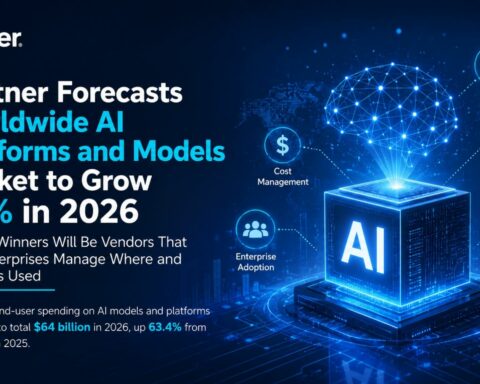
So, what’s the real-world payoff? Adopting Enterprise AI is about much more than simple automation; it’s about securing a decisive competitive advantage. According to forecasts, the global Enterprise AI market is projected to surpass $150 billion by 2030 and that growth is fueled by tangible, transformative benefits. Enterprise AI drives measurable innovation by turning raw data into predictive insights and new revenue streams, democratizing experimentation beyond just data scientists.
This is complemented by a significant boost in operational efficiency, as AI automates repetitive processes and accelerates decision cycles, freeing employees to focus on high-value strategic work. Furthermore, it empowers organizations to make faster, better decisions by embedding real-time machine learning into critical workflows. This culminates in an elevated customer experience, where personalization at scale becomes a reality, ultimately improving satisfaction, reducing churn and driving revenue.
Transforming Industries from the Inside Out
The strategic impact of Enterprise AI is already being felt across industries. In research and innovation, AI cuts product development cycles from years to months by analyzing millions of data points to predict which ideas will succeed. For intelligent operations, predictive maintenance ensures factory machines and energy grids can schedule their own service before a failure occurs, saving millions in unplanned downtime.
For customer-facing businesses, AI makes hyper-personalization practical for millions of users, increasing
lifetime value. In finance, AI models detect anomalies across billions of transactions in real-time, reducing fraud losses and regulatory risks. And in today’s volatile world, AI is building more resilient supply chains by forecasting demand fluctuations based on everything from weather to geopolitical events.
Overcoming Hurdles with a Clear Framework
While the promise is immense, the journey to successful AI adoption is complex. Many organizations stumble over hurdles like fragmented data silos, a shortage of skilled talent and the difficulty of integrating AI with legacy systems. Success requires a structured approach, not ad-hoc experiments. The journey should begin by defining clear business objectives and measurable KPIs to ensure AI solves the right problems. From there, the focus must shift to building a solid data foundation by consolidating silos and ensuring data quality.
With a strong data pipeline in place, the next step is to choose the right platform, evaluating whether to build a custom solution or buy one that offers scalability and easy integration. It’s wise to start small with a pilot project in a single department to validate the model and demonstrate value, which helps build momentum. Finally, AI is not a “set it and forget” technology; continuous monitoring and optimization through feedback loops are essential to ensure the models remain effective and aligned with business goals.
What’s on the Horizon for Enterprise AI?
The evolution is accelerating. The next wave of Enterprise AI is about autonomous intelligence and creative systems that will fundamentally reshape how businesses operate. We’re seeing the rise of AI agents which are autonomous systems capable of managing end-to-end processes like employee onboarding or financial reconciliation without human intervention. These agents can function as digital co-workers, integrated into business applications like ERP and CRM, driving productivity beyond what rule-based automation can achieve.
Generative AI is extending the capabilities of Enterprise AI far beyond prediction, moving into the realms
of creation and ideation. Using large language models (LLMs) and multimodal AI, GenAI will be instrumental in generating personalized content at scale, from marketing copy and unique product descriptions to dynamic customer offers tailored to individual preferences. It will also help build high- quality synthetic datasets, allowing for robust model training while preserving data privacy.
Furthermore, GenAI is set to accelerate software delivery and reduce costs by enabling automated code generation and development. Crucially, it will support a higher level of decision intelligence by providing creative solutions for complex and ambiguous problems where traditional rule-based systems often fail.
Ultimately, integrating AI is about building a more intelligent, agile and resilient organization. The companies that embrace it strategically, as a core part of their DNA, will be the ones that lead their industries for years to come.