



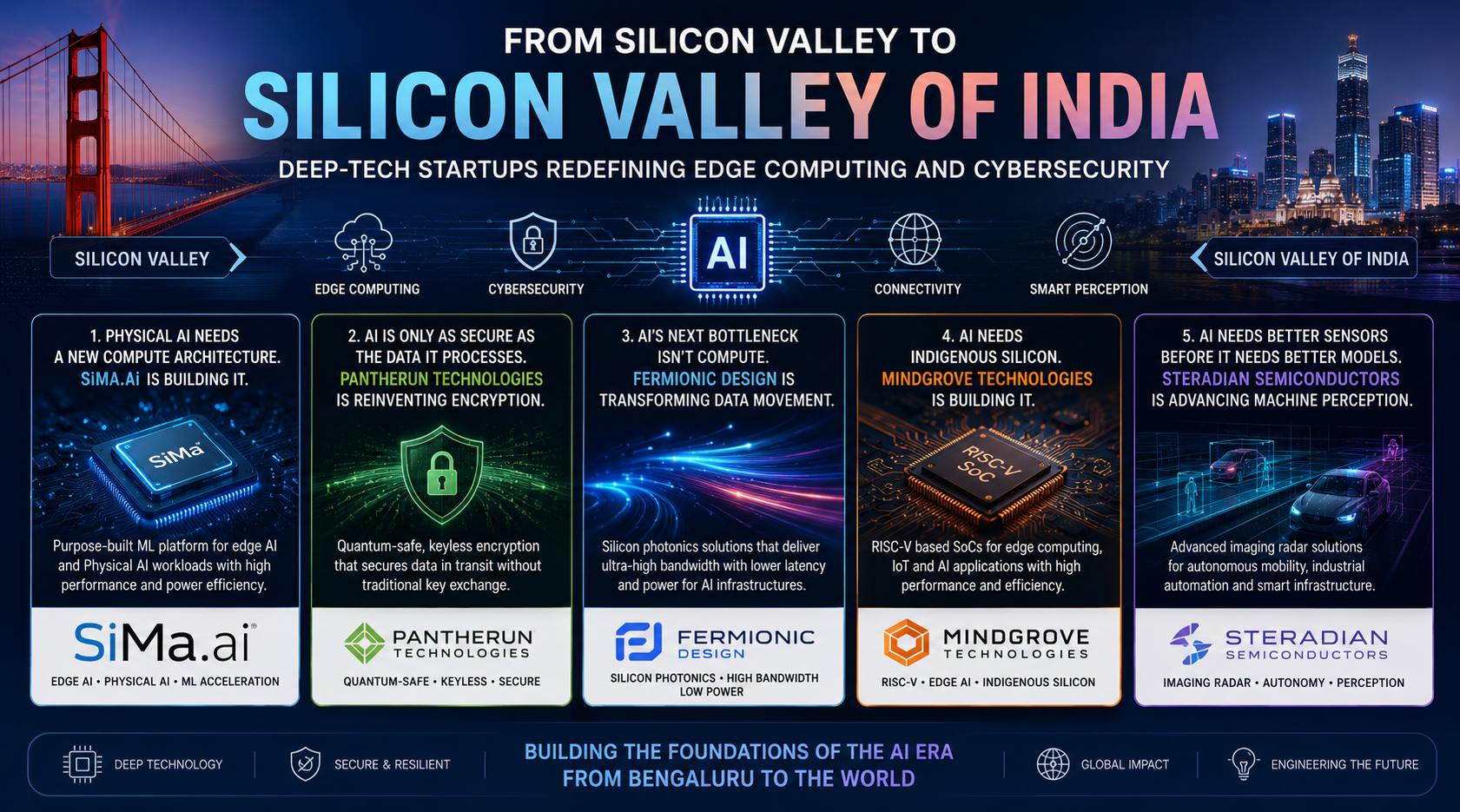
Artificial intelligence has become synonymous with foundation models, copilots and generative AI. Yet none of these systems exists in isolation. Every AI workload depends on a much larger technology stack comprising specialised processors, high-speed interconnects, secure communications, intelligent sensing and resilient networking. These foundational technologies rarely command the same attention as AI applications, but they determine whether AI can operate reliably, efficiently and securely at scale.
Bengaluru has quietly become one of the few technology ecosystems where each of these critical layers is being developed. From edge AI processors and quantum-safe encryption to silicon photonics, software-defined communications and radar imaging, the city is home to companies solving some of the hardest engineering problems in modern computing.
Here are five Bengaluru companies helping build the infrastructure behind the AI era.
- Physical AI Needs a New Compute Architecture. SiMa.ai Is Building It.
The explosive growth of generative AI has brought unprecedented attention to cloud GPUs, but a significant share of AI workloads never reaches a data centre. Industrial robots, autonomous vehicles, medical imaging systems, drones and smart factories must execute inference locally, often within strict power, thermal and latency constraints. Traditional compute architectures were never designed for these environments.
SiMa.ai addresses this challenge with a purpose-built machine learning platform optimised for edge AI and Physical AI workloads. Its architecture combines dedicated machine learning acceleration with a software-first development environment that allows developers to deploy sophisticated AI models across a wide range of hardware platforms. As AI increasingly moves into machines interacting with the physical world, efficient edge inference will become just as important as raw compute performance.
- AI Is Only as Secure as the Data It Processes. Pantherun Technologies Is Reinventing Encryption.
Every AI system depends on the continuous movement of data. Training datasets, inferencing engines, connected devices and autonomous platforms constantly exchange sensitive information across networks. While much of the industry’s attention remains focused on model performance, the security of the underlying data is becoming an equally important engineering challenge, particularly as quantum computing threatens many of today’s cryptographic methods.
Pantherun Technologies is tackling that challenge through quantum-safe, keyless encryption designed to eliminate traditional key exchange vulnerabilities. Its approach secures data in transit without relying on conventional key distribution, making it particularly relevant for defence, financial services, telecommunications and other sectors where resilience is non-negotiable. As AI systems become more distributed and interconnected, cryptographic innovation will become as fundamental as advances in compute.
- AI’s Next Bottleneck Isn’t Compute. FermionIC Design Is Transforming Data Movement
The performance of modern AI systems is increasingly constrained by how quickly information can move between processors, memory and storage. Even the most powerful accelerators deliver diminishing returns if data cannot reach them efficiently. This challenge has intensified with larger AI models, where bandwidth and energy consumption have emerged as critical limitations.
FermionIC Design is developing silicon photonics technologies that replace conventional electrical interconnects with optical communication. By moving data using light instead of electrical signals, silicon photonics significantly improves bandwidth while reducing latency and power consumption. As hyperscale AI infrastructure continues to expand, technologies that accelerate data movement are expected to become a defining component of next-generation computing.
- AI Needs Indigenous Silicon. Mindgrove Technologies Is Building It.
As AI becomes more deeply embedded across edge devices and connected infrastructure, the demand for specialised processors is growing rapidly. Building indigenous semiconductor capabilities is becoming increasingly important as countries prioritise resilient supply chains and technological self-reliance.
Mindgrove Technologies is addressing this need through RISC-V-based System-on-Chips (SoCs) designed for edge computing, IoT and AI-enabled applications. By combining high performance with power efficiency, its processors support intelligent embedded systems across industries. As AI increasingly moves closer to where data is generated, homegrown chip innovation will play a critical role in strengthening India’s deep-tech ecosystem.
- AI Needs Better Sensors Before It Needs Better Models. Steradian Semiconductors Is Advancing Machine Perception.
An AI model can only make decisions based on the quality of information it receives. For autonomous systems operating in the physical world, sensing technologies are therefore as important as computing power. Cameras, radar and other perception systems must accurately detect and interpret complex environments under a wide range of operating conditions.
Steradian Semiconductors develops advanced imaging radar solutions for applications including autonomous mobility, industrial automation and smart infrastructure. Radar complements optical sensing by operating reliably in darkness, rain, fog and other challenging environments where cameras alone may struggle. As industries move towards greater autonomy, robust perception technologies will remain central to safe and dependable AI systems.
Bengaluru’s Deep-Tech Ecosystem Is Building More Than AI Applications
Conversations around artificial intelligence often focus on the applications people interact with. The technologies beneath those applications receive far less attention despite being equally fundamental. Without specialised processors, secure communications, photonic interconnects, adaptive networks and advanced sensing, even the most sophisticated AI model cannot move beyond the laboratory.
Bengaluru’s deep-tech ecosystem is increasingly contributing to these foundational technologies, reinforcing the city’s position not merely as India’s software capital, but as one of the few places where multiple layers of the global AI infrastructure stack are being engineered simultaneously. Companies like SiMa.ai, Pantherun Technologies, FermionIC Design, Saankhya Labs and Steradian Semiconductors demonstrate that the city’s next chapter in AI may well be written not through applications alone, but through the technologies that make those applications possible.