


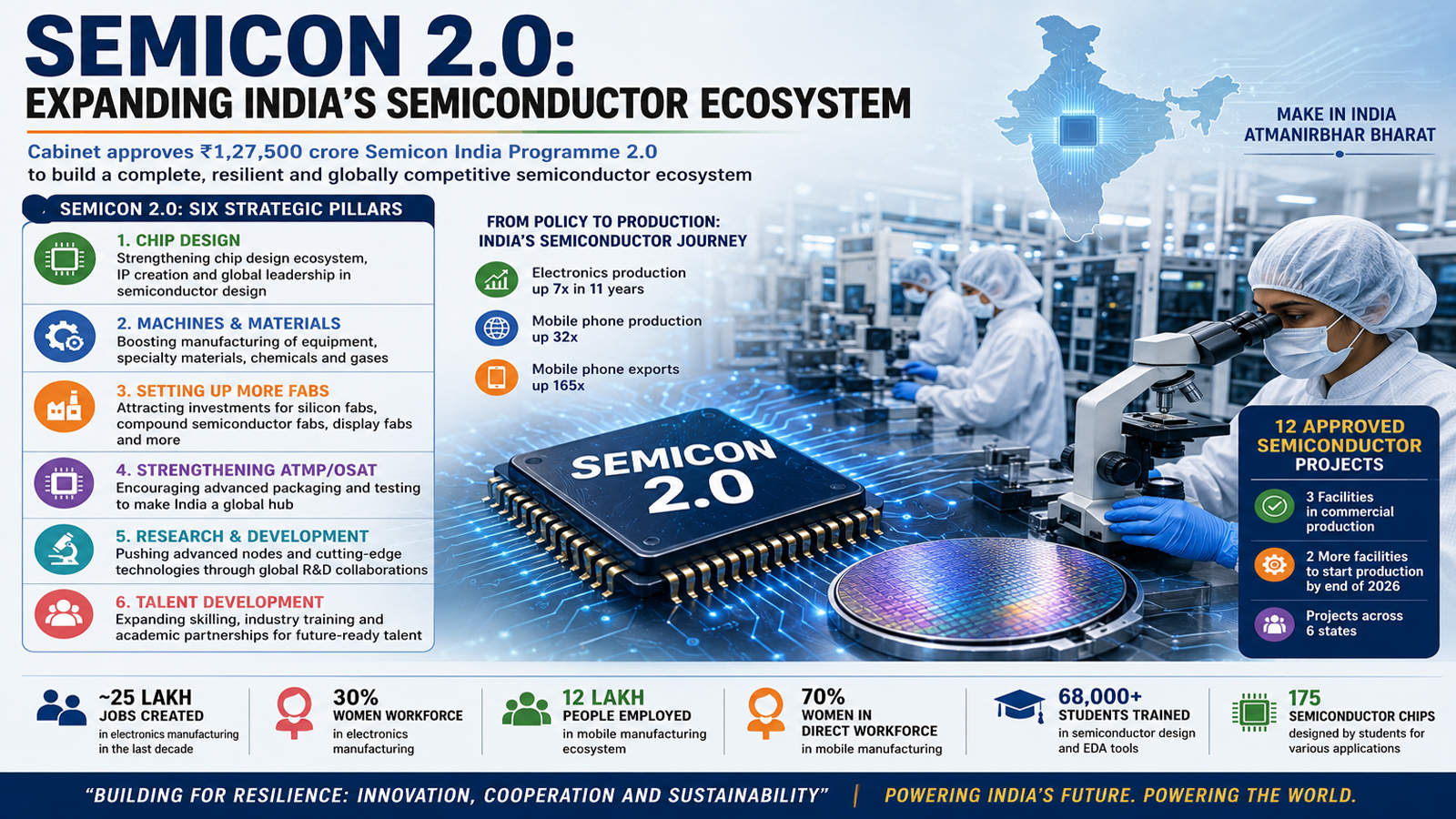
The global electronics landscape is undergoing a massive geopolitical realignment, and India is positioning itself at the epicenter. In a decisive move to secure high-tech manufacturing autonomy, the Union Cabinet officially approved the Semicon India Programme 2.0, backed by an unprecedented financial commitment of ₹1,27,500 crore. This expanded framework builds directly upon the groundwork laid by the initial ₹76,000-crore Semicon 1.0 initiative, transforming a foundational incentive scheme into a long-term, comprehensive manufacturing and engineering ecosystem.
A Multidimensional Strategy for the Supply Chain
Where the first phase focused heavily on attracting foundational fabrication units, Semicon 2.0 expands its operational scope to insulate India from global supply chain vulnerabilities. The program introduces a specialized financial support framework divided into six strategic pillars:
-
Chip Design & Intellectual Property: Incubation support for domestic startups to design proprietary integrated circuits.
-
Manufacturing Equipment: Subsidies aimed at building localized machinery needed to operate high-tech cleanrooms.
-
Raw Materials & Chemicals: Incentivizing the local production of ultra-pure gases, silicon wafers, and specialized substrates.
-
Advanced Packaging & Testing: Accelerating ATMP (Assembly, Testing, Marking, and Packaging) operations to complete the manufacturing loop domestically.
-
Research & Development: Funding specialized labs to pioneer next-generation material sciences and quantum computing architectures.
-
Talent Cultivation: A nationwide educational rollout expanding specialized chip-design and microelectronics curricula to over 500 universities.
Geopolitical and Economic Implications
By directly subsidizing everything from raw silicon processing to finished advanced packaging, India is attempting to minimize its historical reliance on East Asian supply hubs. For multinational electronics brands, the upgraded policy turns India into an attractive, de-risked alternative for end-to-end hardware development.
Ultimately, Semicon 2.0 is not merely an industrial incentive package; it is a strategic blueprint designed to transition the nation from a massive consumer of technology into an indispensable, self-reliant global exporter of silicon.