
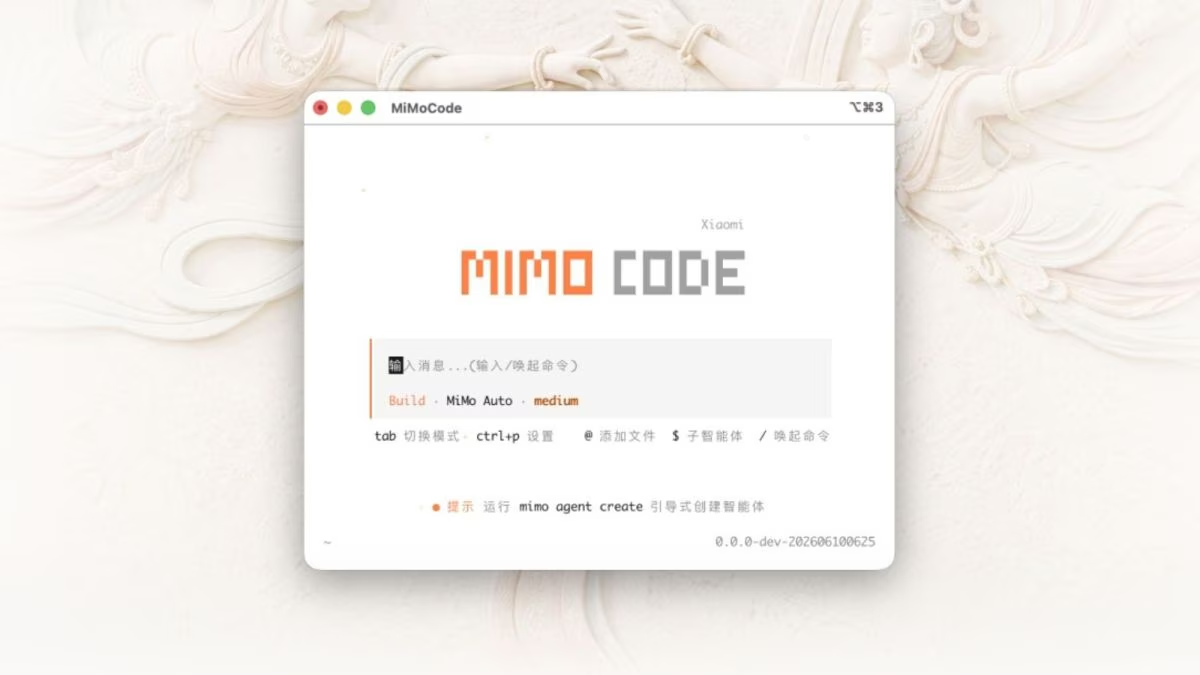
Xiaomi has officially entered the competitive landscape of AI-driven software development by open-sourcing its latest tool, “MiMo Code V0.1.0.” Developed as a terminal-native AI coding assistant, this innovative platform is specifically engineered to tackle long-horizon, multi-step engineering tasks. Unlike standard coding assistants that handle basic snippet completions, MiMo Code is built to independently navigate complex software repositories, execute terminal commands, and systematically resolve intricate bugs without constant user intervention.
The tool is powered by Xiaomi’s proprietary MiMo V2.5 Pro foundational model and utilizes the open-source OpenCode framework. To manage large-scale software projects effectively, Xiaomi has integrated a sophisticated persistent memory architecture alongside a dedicated “checkpoint-writer” subagent. This secondary system acts as a safety layer, constantly saving progress and maintaining full situational context across long sequential workflows. If an execution path fails, the system can seamlessly roll back to a stable checkpoint and attempt a different coding strategy.
Xiaomi’s internal evaluations suggest that MiMo Code is highly competitive against established industry alternatives. The company claims its new assistant outperforms Anthropic’s Claude Code on complex benchmarks, achieving an impressive 82% success rate on the SWE-bench Verified test. Furthermore, in extensive human A/B testing, MiMo Code achieved a win rate of over 65% when executing intricate tasks that required more than 200 sequential steps. By open-sourcing the repository on GitHub, Xiaomi aims to foster community-driven optimization and accelerate its integration into enterprise environments. As tech giants continue to automate complex software engineering, Xiaomi’s aggressive push into developer tools signals an intense battle ahead for mainstream AI coding dominance.