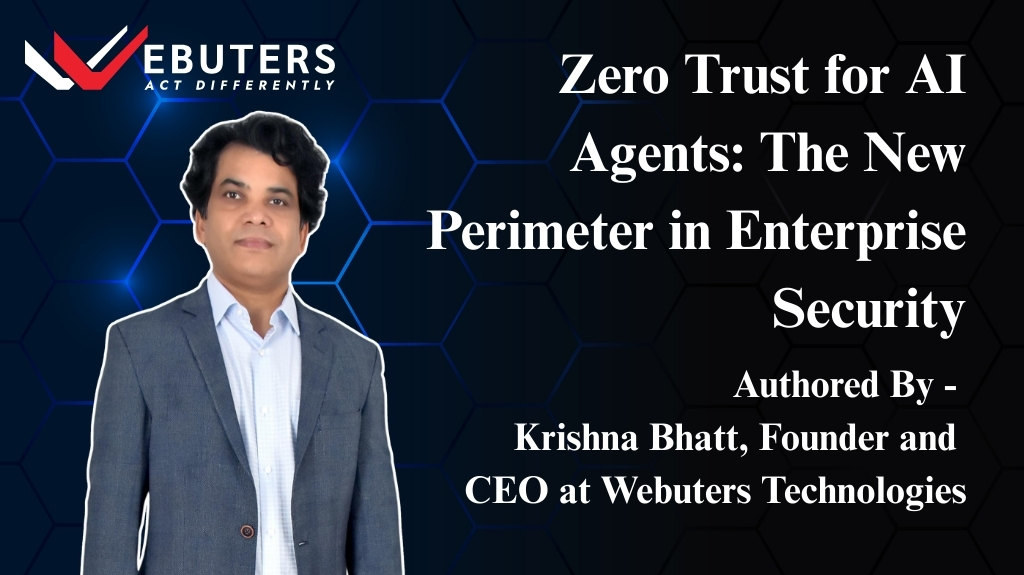
“Never trust, always verify” is the foundation of the Zero Trust security framework. Zero Trust necessitates constant authentication and permission for each user, device, and system—regardless of location—in contrast to conventional approaches that presume everything within a network is secure. This means that until the opposite is demonstrated, AI agents should consider every action, data request, and choice to be potentially dangerous.
The special features of AI agents make Zero Trust even more important. They are dynamic, frequently responding to new data or machine learning models. They also connect with a variety of systems, from internal databases to third-party APIs, resulting in various sources of vulnerability. According to a forecast, more than 80% of organizations plan to implement Zero Trust strategies by 2026 to reduce risks. This shows how important this strategy is growing.
Implementing Zero Trust for AI Agents
So, how do you implement Zero Trust for AI agents? It begins with redefining security from the bottom. Here are the important steps that organizations can take.
- Identity Verification for AI Agents.
Every AI agent requires a distinct and verifiable identification. This could include cryptographic keys or digital certificates that verify the agent before it can access data or systems. For example, an AI agent studying financial records should be validated at each stage to ensure it is neither a rogue process or a corrupted clone. Multi-factor authentication (MFA) for AI agents is becoming commonplace in high-security environments, despite its complexity.
- Least Privilege Access
AI agents should have access to only the data and systems they need to do their duties. If an agent is compromised, the concept of least privilege reduces the damage caused. For example, an AI handling inventory should not have access to employee payroll information. RBAC and ABAC allow permissions to be dynamically adjusted based on the agent’s role and context.
- Continuous Monitoring and Anomaly Detection
Zero Trust necessitates real-time monitoring of AI agent activity. By creating a baseline of “normal” activity, businesses can (ironically) utilize machine learning to discover anomalies, such as an AI agent seeking odd data or departing from its usual decision-making habits. Behavioural analytics and SIEM systems are essential tools in this context.
- Data Security and Segmentation
Data accessed or generated by AI agents must be encrypted both at rest and during transmission. Network segmentation further isolates AI processes by preventing lateral mobility if an agent is compromised. For example, an AI addressing client requests may work in a segregated environment, unable to access essential financial systems.
Challenges and the Way Ahead
Adopting zero trust for AI agents is not without challenges. First, there is the challenge of maintaining identities and access for possibly thousands of AI agents in a large enterprise. Second, continual monitoring necessitates substantial computational resources, which might strain budgets. Finally, there is the human factor: employees and engineers must be properly taught to deploy and maintain Zero Trust policies.
Despite these problems, the alternative—leaving AI agents vulnerable—is far more dangerous. According to a Forrester study conducted in 2025, 60% of data breaches involved misconfigured or inadequately secured AI systems. The stakes are huge, and companies cannot afford to fall behind.
The Prospects of Enterprise Security
As AI agents grow more integrated into company operations, Zero Trust has grown as the gold standard for their security. It is a lot more than data security; it is also about ensuring that autonomous systems operate inside a framework of transparency and trust. Businesses may maximize their influence while preserving their most important assets by identifying every AI agent as a potential risk.
The new periphery is not a firewall or a network border but rather a dynamic, self-verifying system that can keep up with AI’s intelligence and agility. As we reach 2026 and beyond, firms that implement Zero Trust for their AI agents will not only be secure but will also have an edge in a world where trust is acquired rather than granted.