Kaspersky Lab, in cooperation with B2B International, has conducted a survey* among company representatives to find out their attitudes towards information security, including financial companies’ policies towards protection from online fraud. The
Kaspersky Lab, in cooperation with B2B International, has conducted a survey* among company representatives to find out their attitudes towards information security, including financial companies’ policies towards protection from online fraud. The
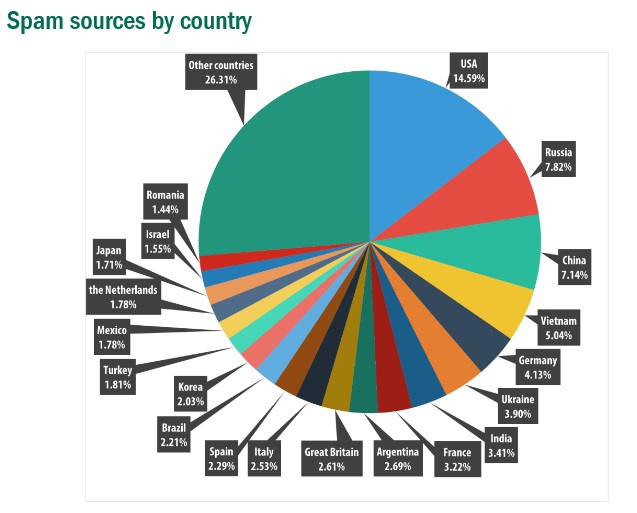
Kaspersky Lab’s latest report – ‘spam and phishing in Q2 of 2015’ – reveals spam in the second quarter of 2015 was dominated by letters based on real events. Spam ‘Nigerian’ letters

Spammers produced topical new versions of the old “Nigerian Letter” scam, this time based on the Ebola virus. According to Kaspersky Lab experts several mass mailings in September exploited this theme. Spam
Less than one-third of businesses keep their virtualization servers on-premises and managed entirely by their own internal IT staff, according to a Kaspersky Lab survey of 3,900 IT professionals worldwide. As virtual
Security experts from Kaspersky Lab’s Global Research and Analysis Team shared the security measures they use to protect their own communications via email, instant messaging tools, smartphones, and while browsing over computer
According to the results of the “Mobile cyber-threats” survey carried out by Kaspersky Lab and INTERPOL between August 2013 and July 2014, every fifth Android-based device protected by Kaspersky Lab security solutions
Kaspersky Lab’s experts performed a forensic investigation into cyber-criminal attacks targeting multiple ATMs around the world. During the course of this investigation, the company’s researchers discovered a piece of malware infecting ATMs
Very small businesses (VSBs) with fewer than 25 employees have the same rate of mobile device
ZyXEL Communications and Kaspersky Lab are delighted to announce that ZyXEL’s newly introduced line of next-generation UTM firewalls integrates Kaspersky Lab’s breakthrough anti-malware technologies. The companies’ long-term cooperation and ultimate integration present
According to a Kaspersky Lab survey of 3,900 IT professionals worldwide, Financial Services and Healthcare are the two business sectors most likely to see security concerns as a barrier to implementing IT
According to a survey conducted by Kaspersky Lab and B2B International, 49% of Internet users worldwide felt vulnerable while shopping online or making online transactions, and 42% of users would utilize online

Popular connected home entertainment devices pose a real cyber security threat due to vulnerabilities in their software, and a lack of elementary security measures such as strong default administrator passwords and encryption of Internet
