Generative artificial intelligence (GenAI) chatbots are quickly becoming a primary interface between enterprises and users. They now appear in customer support portals, employee assistants, e-commerce flows, sales applications, and internal knowledge systems. In many deployments, the chatbot is no longer a standalone front end. It is connected to application logic, APIs, retrieval systems, enterprise content, and sometimes downstream actions.That changes the security problem.
A GenAI chatbot is still a web application and API-driven service, so the surrounding application stack still needs strong application-layer protection. But the chatbot itself introduces a new conversational attack surface. The user is no longer limited to predefined fields or predictable parameters. Instead, the application accepts open-ended natural language, and that creates room for prompt injection, data leakage, harmful output, and resource abuse.
This is where Check Point WAF matters. It extends application security into the GenAI interaction layer, helping organizations protect chatbots as they move from experimentation into production.
Why is GenAI chatbot security different from web security
Traditional web applications are comparatively bound. Users click buttons, submit forms, or invoke APIs with known structures. Security controls can validate requests against expected schemas, behaviors, and workflows.
Chatbots are different in two important ways.
- First, interaction is open-ended. The same intent can be expressed in countless ways, including obfuscation or multilingual phrasing. That makes malicious intent harder to detect with simple pattern matching.
- Second, the response itself becomes part of the security problem. In a classic web app, the main goal is often to prevent malicious requests from reaching the server. In a chatbot, the organization also needs to prevent the model from returning sensitive, unsafe, or policy-violating content.
This is why traditional web application security alone is not enough for GenAI-enabled applications.
The chatbot threat model: what goes wrong
For a production chatbot, the risks are not theoretical. Public incidents have already shown that GenAI applications can be manipulated, can expose unsafe behavior, and can return harmful or misleading responses. In practice, security teams need to focus on the below application-level risk areas-
- Prompt injection
Prompt injections remain the most visible GenAI application threat. Attackers try to manipulate the model with instructions that override intended behavior, expose hidden instructions, bypass safeguards, or force the model into unsafe actions.
Some attacks are direct, meaning the malicious content is placed directly in the conversation. Others are indirect, which is often more dangerous in enterprise chatbot deployments. In indirect prompt injection, the malicious instruction is embedded in retrieved documents, uploaded files, linked content, or external data sources that the chatbot consumes as context.
- Data leakage
Chatbots are valuable because they can access information. They may retrieve internal knowledge, answer account-specific questions, summarize documents, or connect to enterprise systems. That same access also expands the risk of exposing confidential data.
An attacker may try to extract information through carefully crafted prompts. In other cases, the model may reveal sensitive data unintentionally because a conversation steers it outside the intended boundaries. The risk can include personally identifiable information (PII), internal documents, financial data, proprietary instructions, credentials, and other high-value content.
- Harmful or policy-violating output
Even when infrastructure is intact, the response itself can create immediate business risk. A customer-facing chatbot that returns abusive, offensive, misleading, or unsafe content can damage trust very quickly. An internal chatbot that produces disallowed or non-compliant content can create governance and compliance problems just as fast.
This is why chatbot protection must cover both what goes into the model and what comes out.
Why unified application security matters?
There is a common misconception that chatbot security is only a guardrails problem. It is not. A chatbot is still an application. It still exposes HTTP traffic. It still relies on APIs, sessions, authentication, and application logic. It may also depend on supporting services that need schema validation, sensitive data visibility, and broader application-layer protection.
That means the chatbot use case needs both of the following:
- Strong web application and API security for the application around chatbot.
- GenAI-aware protections for prompts, context, model responses, and abuse patterns.
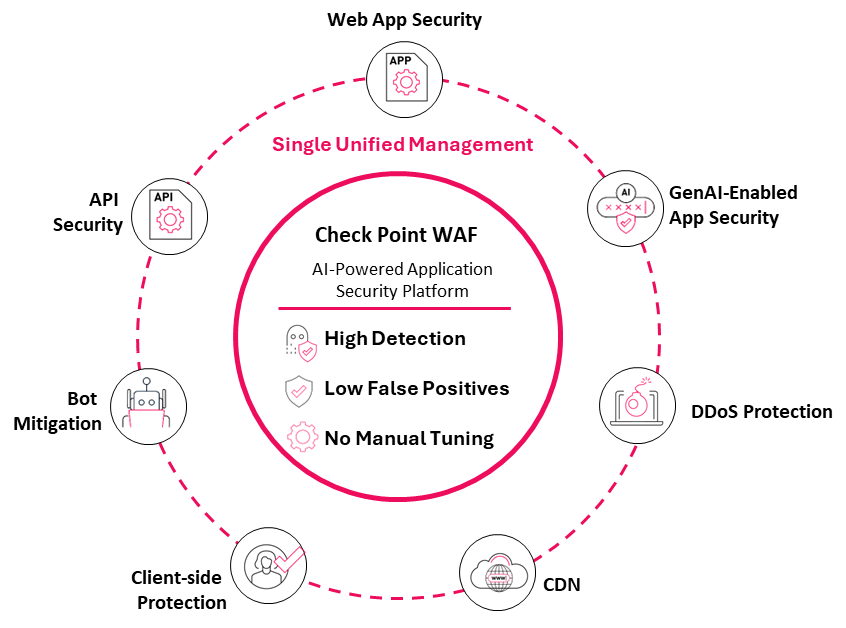
Check Point WAF brings these layers together through a single unified management, protecting the application stack while extending inspection directly into GenAI interactions.
 How Check Point WAF secure GenAI chatbots
Check Point WAF is designed to secure the chatbot interaction as part of the broader application flow.
For GenAI-enabled applications, Check Point WAF focuses on core protection areas: prompt injection prevention, data leakage prevention, content control, and usage control. These are the controls that matter most for enterprise chatbot deployments.
At a high level, the protection model combines two complementary machine learning layers.
- The first layer is a pre-trained supervised model built on millions of prompts and attack patterns, strengthened with more than 85M+ prompt attempts (dataset from Lakera’s Gandalf game). This layer handles the majority of GenAI traffic and is designed to detect suspicious or malicious behavior with high accuracy and low latency. It provides the initial classification for prompt injections, sensitive data leakage, harmful content, and usage abuse.
- The second layer applies contextual and semantic analysis. This is important because not every unusual prompt is malicious in the context of a specific chatbot. Context matters. A support assistant, an internal IT bot, and a healthcare chatbot all have different expected behaviors. Contextual inspection helps evaluate user behavior, request patterns, and what is normal for that application, improving accuracy while reducing false positives.
This dual-layer approach is one of the most important architectural advantages for chatbot security. It combines broad GenAI threat detection with application-specific understanding.
Why latency and language coverage matter in the chatbot experience
Security for chatbots must be effective, but it should also fit the user’s experience. Unlike many background security controls, chatbot protections sit directly in the user’s interaction path. Excessive inspection delays are visible immediately.
Check Point WAF provides -50 millisecond latency; that matters because users already wait on model inference. Security cannot become the reason the chatbot feels unusable.
Language coverage matters too. Enterprises increasingly deploy chatbots for global users, and prompt attacks are not limited to English. Check Point WAF provides protections across 100+ languages and scripts, which is important for real-world deployments where prompts, obfuscation, and sensitive data exposure may appear across multiple languages in the same conversation.
Conclusion
GenAI chatbots are moving from low-risk experiments into customer-facing and business-critical workflows. Once connected to internal data, APIs, or downstream actions, a prompt-driven incident can quickly become a data exposure, brand, computer misuse, or application security issue. That is why chatbots must be treated as high-value application interfaces, not side features
Check Point WAF helps organizations secure GenAI chatbots by extending proven web application and API protection into the conversational layer, helping block prompt injections, reduce data leakage risk and control harmful output as GenAI applications move into production.