


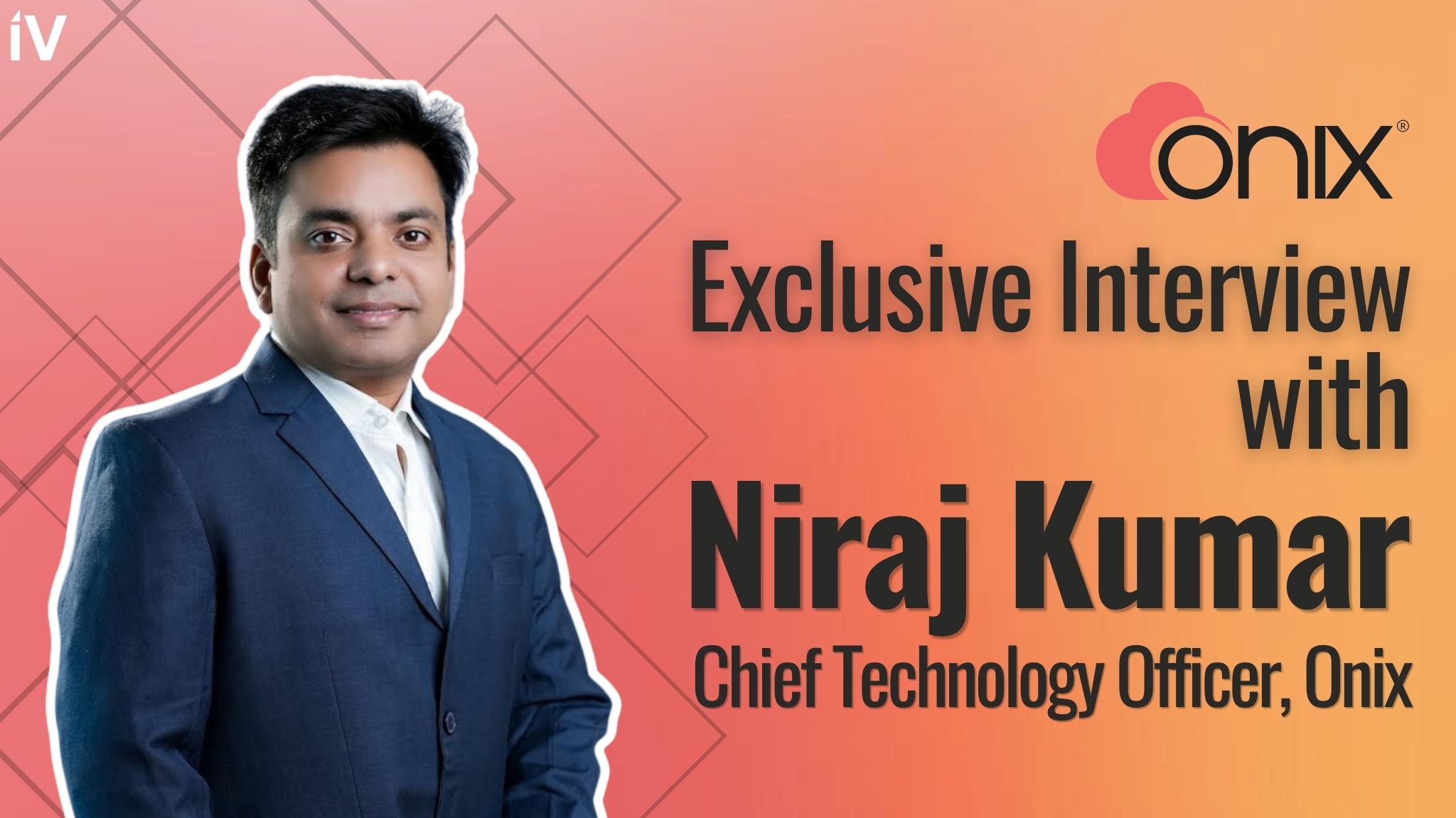
In this exclusive interview with Mr. Niraj Kumar, Chief Technology Officer of Onix, he explains how AI, cloud, and intelligent data platforms are converging to reshape enterprise operations and real-time decision-making. He also shares insights into Wingspan AI’s agentic architecture, domain-specific AI agents, and the future of responsible, scalable AI adoption across industries.
IT Voice- As the Chief Technology Officer of Onix, how do you see AI-driven transformation reshaping enterprise operations and business decision-making across industries?
Niraj Kumar- AI-driven transformation is reshaping enterprise operations by fundamentally changing how decisions are made and executed across the organization. What we are seeing is a clear shift away from reactive, intuition-led approaches toward systems that can generate and act on intelligence in real time. This is not just an incremental improvement but a structural change in how businesses operate on a day-to-day basis.
In practice, this shift is unfolding in two important ways. Operations are becoming increasingly autonomous, with systems able to adapt to changing conditions without constant intervention, while decision-making is becoming far more precise because it is grounded in continuously updated data and context. Instead of following a linear cycle of collecting data, analyzing it, and then responding, enterprises are moving toward a continuous loop where insights are generated, validated, and acted upon in real time.
From our experience working with over 1,500 enterprises across industries such as healthcare, retail, financial services, telecom, and the public sector, one pattern stands out. Organizations that embed AI as a foundational layer across their workflows, rather than treating it as a standalone capability, are the ones seeing sustained, measurable impact. The real opportunity lies in creating environments where intelligence is always current, accessible, and directly aligned with business outcomes.
IT Voice- Onix recently introduced Wingspan AI, an industry-first multi-capability agentic AI platform. What inspired the development of this platform, and what key challenges does it aim to solve for enterprises?
Niraj Kumar- The inspiration behind Wingspan came from a persistent gap observed as enterprises moved toward AI-first operations. Despite significant investments in data platforms and models, the journey from raw data to usable intelligence remained fragmented, heavily manual, and difficult to scale in a controlled manner. Teams were often spending more time stitching systems together and maintaining context across environments than actually driving outcomes, which ultimately limited the business value AI could deliver.
Wingspan was built to address this at a structural level by rethinking the transformation journey as a coordinated, agent-driven system rather than a collection of disconnected tools. It brings together proprietary capabilities such as Eagle for enterprise discovery, assessment, and knowledge graph generation, Raven for legacy data modernization, Pelican for validation, and Kingfisher for synthetic data generation, each targeting a specific point of friction in the lifecycle. These are further strengthened through a semantic twin layer, which helps maintain contextual continuity across systems, ensuring that enterprise meaning is preserved as data moves through different stages of transformation.
At a broader level, the platform is designed to solve three core challenges that continue to hold enterprises back: fragmented data environments, lack of confidence in data accuracy, and the operational complexity of scaling AI. With integrated FinOps and Observability 360, it also ensures that performance and cost remain tightly governed as adoption expands, enabling enterprises to scale intelligence in a controlled and sustainable way.
IT Voice- Agentic AI is emerging as the next evolution of enterprise intelligence. How do you see domain-specific AI agents transforming productivity, automation, and real-time decision-making in organizations?
Niraj Kumar- Agentic AI, especially in the form of domain-specific agents, marks a clear shift in how enterprises derive value from AI because it brings intelligence much closer to the way business functions actually operate. While general-purpose models have proven their potential, they often struggle in environments where workflows are layered, data is distributed, and outcomes depend on deep functional context. Domain-specific agents bridge this gap by understanding how different parts of the business work in practice, not just in theory.
That shift becomes immediately visible in productivity. Tasks that once required human effort to interpret data, navigate systems, and validate outputs can now be handled more seamlessly, allowing teams to redirect their focus toward higher-impact work. This naturally extends into automation, where the model moves away from rigid, rule-based execution toward systems that can adjust dynamically as conditions change and new signals emerge.
The real transformation, however, shows up in decision-making. With context embedded into how these agents operate, and with continuous validation built into their execution, decisions are both faster and more grounded in real-time conditions. Over time, this creates an operating model where the business is not just responding to change, but staying aligned with it as it happens.
IT Voice- Many enterprises struggle to move from data collection to actionable AI insights. How does Wingspan AI help organizations accelerate their data-to-AI transformation journey?
Niraj Kumar- Enterprises often find that the real challenge begins after data is collected, when the focus shifts to turning legacy data warehouse environments into production-ready AI systems. This transition is typically slowed by disconnected systems, manual dependencies, and the need to maintain governance at every step. Wingspan is designed to address this directly through intelligent automation that removes these bottlenecks without compromising reliability.
Its acceleration capability is anchored in an agentic architecture, where specialized agents take on critical functions such as data preparation, code transformation, validation, synthetic data generation, and model deployment. These processes are executed in a coordinated manner, allowing organizations to reduce production timelines by two to three times, often bringing go-live cycles down to just a few weeks while maintaining strict standards for accuracy and compliance. Across deployments, this translates into 50–80% reduction in manual effort across data-intensive processes.
This speed is supported by built-in stability mechanisms. Pelican-powered validation agents continuously monitor data quality in real time, ensuring integrity throughout the pipeline, while Phoenix AI Studio enables ongoing model tuning and performance optimization as systems evolve. The integration of a unified knowledge graph further shortens the learning curve by embedding enterprise-specific context early in the process.
To ensure that this acceleration remains controlled, Wingspan incorporates governance, observability, and security as embedded layers, enabling rapid deployment cycles that are transparent, traceable, and aligned with enterprise requirements.
IT Voice- Context-aware AI platforms are becoming increasingly important in modern enterprises. How critical is data quality, governance, and cloud infrastructure in building effective AI ecosystems?
Niraj Kumar- Data quality, governance, and cloud infrastructure are not supporting elements in an AI ecosystem, they are the foundation it is built on. No matter how advanced the models or platforms become, their effectiveness ultimately depends on the reliability of the data they operate on. If that data is inconsistent or lacks proper oversight, the outputs quickly lose credibility, and with that, confidence in AI-driven decisions starts to decline.
This is why these elements need to be addressed upfront rather than introduced later as controls. Data quality has to be continuously enforced across the entire pipeline, not just at the point of ingestion, because issues can emerge at any stage and impact downstream outcomes. Governance follows the same principle, where it must be embedded into execution so that compliance is ensured before decisions are acted on, rather than being reviewed retrospectively.
Cloud infrastructure plays a critical role in enabling this foundation to scale. It provides the flexibility and interoperability needed to support evolving workloads without creating additional silos or technical debt. When these three dimensions are aligned from the start, enterprises are able to build AI ecosystems that are not only high-performing but also dependable and sustainable over time.
IT Voice- Generative AI adoption is growing rapidly, but scalability remains a concern for many businesses. What are the biggest barriers enterprises face while implementing AI at scale, and how can they overcome them?
Niraj Kumar- Scaling AI across an enterprise is fundamentally different from running a successful pilot, and that gap is where most organizations get stuck. The barriers are not primarily technological, they are structural. The first is the absence of an AI-ready data foundation. Without clean, contextualized, and continuously maintained data, models cannot perform reliably at scale, and outcomes begin to lose consistency as adoption expands.
The second barrier is the lack of organizational alignment. In many enterprises, AI initiatives remain confined to individual teams or functions, which prevents them from operating as a shared capability across the business. This fragmentation limits the ability to generate coordinated impact and slows down enterprise-wide adoption. The third challenge is cost unpredictability. As AI usage grows, the lack of FinOps discipline often leads to rapidly increasing cloud spend that becomes difficult to track, justify, or optimize.
Overcoming these barriers requires a shift in how AI transformation is architected. Enterprises need platforms that automate the work of building and maintaining the data foundation, along with agents that can operate across functions with shared context. At the same time, financial governance mechanisms must provide real-time visibility into consumption and waste. Organizations that take this integrated approach are able to scale faster, control costs more effectively, and sustain adoption beyond the initial proof-of-concept stage.
IT Voice- Onix has strong expertise in cloud, analytics, and AI-powered solutions. How do you see the convergence of cloud computing, intelligent data platforms, and AI shaping the future of digital transformation?
Niraj Kumar- The convergence of cloud computing, intelligent data platforms, and AI is gradually reshaping digital transformation from a set of technology initiatives into a more cohesive and continuously evolving operating model. What makes this shift meaningful is not just the coming together of these capabilities, but how they now build on each other in a way that changes how enterprises function day to day.
It often begins with the cloud, which removes the traditional constraints of infrastructure and introduces a programmable, elastic foundation. This creates the flexibility enterprises need to scale and adapt without constant reconfiguration. As this foundation expands, intelligent data platforms step in to bring order to growing data volumes, establishing structure, lineage, and meaning so that information remains usable and aligned with business context rather than becoming fragmented.
The transformation becomes more tangible when AI is embedded directly into this environment. At that point, the system is no longer just storing and organizing data, it is actively interpreting it, learning from it, and responding as conditions change. This creates a shift from periodic, insight-driven actions to a more continuous model where intelligence is always available and always influencing operations.
From a transformation standpoint, this convergence allows enterprises to respond to change in real time, accelerate how they build and scale new capabilities, and extract value more consistently across their technology landscape. At Onix, we see this as the emergence of a unified enterprise fabric, where cloud, data, and AI work together to drive sustained innovation and long-term competitive advantage.
IT Voice- Responsible AI and ethical governance have become major industry priorities. What best practices should organizations adopt to ensure secure, transparent, and trustworthy AI deployments?
Niraj Kumar- Responsible AI only becomes meaningful when it is built into how systems operate, rather than applied as a layer of oversight after deployment. In enterprise environments, trust is closely tied to how decisions are made, which means systems need to be designed from the outset to be explainable, auditable, and controlled in real time.
This begins with explainability at the execution level. Every output needs to be traceable back to its source data and underlying logic, so decisions can be understood and validated when required. That foundation naturally extends into continuous model auditing and bias detection. As systems evolve with new data, these checks must run as part of the workflow itself, ensuring outcomes remain consistent and equitable rather than drifting over time.
At the same time, control over data becomes critical. Strong access controls, combined with end-to-end data lineage, provide clear visibility into how information is used, who interacts with it, and how it influences decisions. This creates a level of accountability that is essential for secure and transparent deployments.
Even with these mechanisms in place, human oversight remains an important part of the system, particularly in high-impact scenarios. It ensures that AI supports decision-making without fully abstracting responsibility. Together, these practices create a connected framework where security, transparency, and trust are not separate goals, but inherent characteristics of how AI systems function at scale.
IT Voice- As AI-powered agents become more capable, how do you envision the future collaboration between human teams and intelligent AI systems in enterprise environments?
Niraj Kumar- As AI-powered agents become more capable, the nature of enterprise work is gradually shifting toward a model where tasks are distributed based on the type of intelligence required, rather than the function they sit within. Work that depends on continuous monitoring, pattern recognition at scale, and fast execution within structured boundaries is increasingly being handled by AI systems, simply because these environments reward speed, consistency, and uninterrupted processing.
As this layer of execution becomes more automated, human teams naturally move into a different kind of role. The focus shifts toward areas that require interpretation, judgment, and the ability to work across ambiguity. Instead of being involved in every operational step, people spend more time shaping direction, resolving edge cases, and connecting insights across functions in ways that require context and experience.
For this balance to work in practice, the interaction between the two cannot be static. AI systems need to present their outputs in a way that includes context, highlights uncertainty, and surfaces exceptions, so that results can be questioned rather than simply accepted. Over time, this creates a working rhythm where machine outputs and human input continuously refine each other.
At Onix, we see this playing out in enterprises as a shift toward more integrated workflows, where AI is embedded into how decisions are made day to day, and human input remains a critical part of how those decisions are shaped and validated.
IT Voice- Looking ahead, what emerging innovations and technology trends do you believe will define the next phase of enterprise AI and intelligent automation, and how is Onix preparing for that future?
Niraj Kumar- The next phase of enterprise AI will be shaped by a convergence of capabilities that move systems from being reactive tools to becoming more adaptive and self-sustaining environments. A key part of this shift is semantic intelligence, where systems go beyond pattern recognition to understand meaning and relationships within enterprise data. This becomes critical as organizations look to move from fragmented insights to consistent, context-driven decision-making at scale.
Alongside this, data infrastructure is undergoing a fundamental shift toward self-healing systems. Instead of relying on constant manual intervention, platforms are increasingly expected to detect, diagnose, and resolve issues across pipelines, data quality, and performance on their own. This changes the operational model significantly, reducing maintenance overhead and allowing teams to focus more on innovation and less on system upkeep.
Wingspan is being developed to align with this direction, bringing these capabilities together within a unified approach to enterprise AI. The emphasis is on embedding contextual understanding, operational intelligence, and autonomous data handling into a single framework so that organizations can build AI systems that are not only scalable but also resilient and continuously improving by design.