

For the past two years, most enterprise AI tools have been sophisticated autocomplete. You type, they respond. You prompt, they draft. The work still lands back on the human. That’s changing fast and a new category of AI workspace has emerged that doesn’t wait for instructions. It takes a goal, figures out the steps, and delivers a finished result.
This was fine in 2023, when the novelty of generative AI was enough to justify the spend. It is not fine in 2026. Enterprises have been living with AI assistants for nearly three years now, and the question has shifted from “should we use AI?” to “why is AI still waiting for us to do the work?” The answer is that most tools were never designed to do the work. They were designed to help with it, which is a different thing entirely.
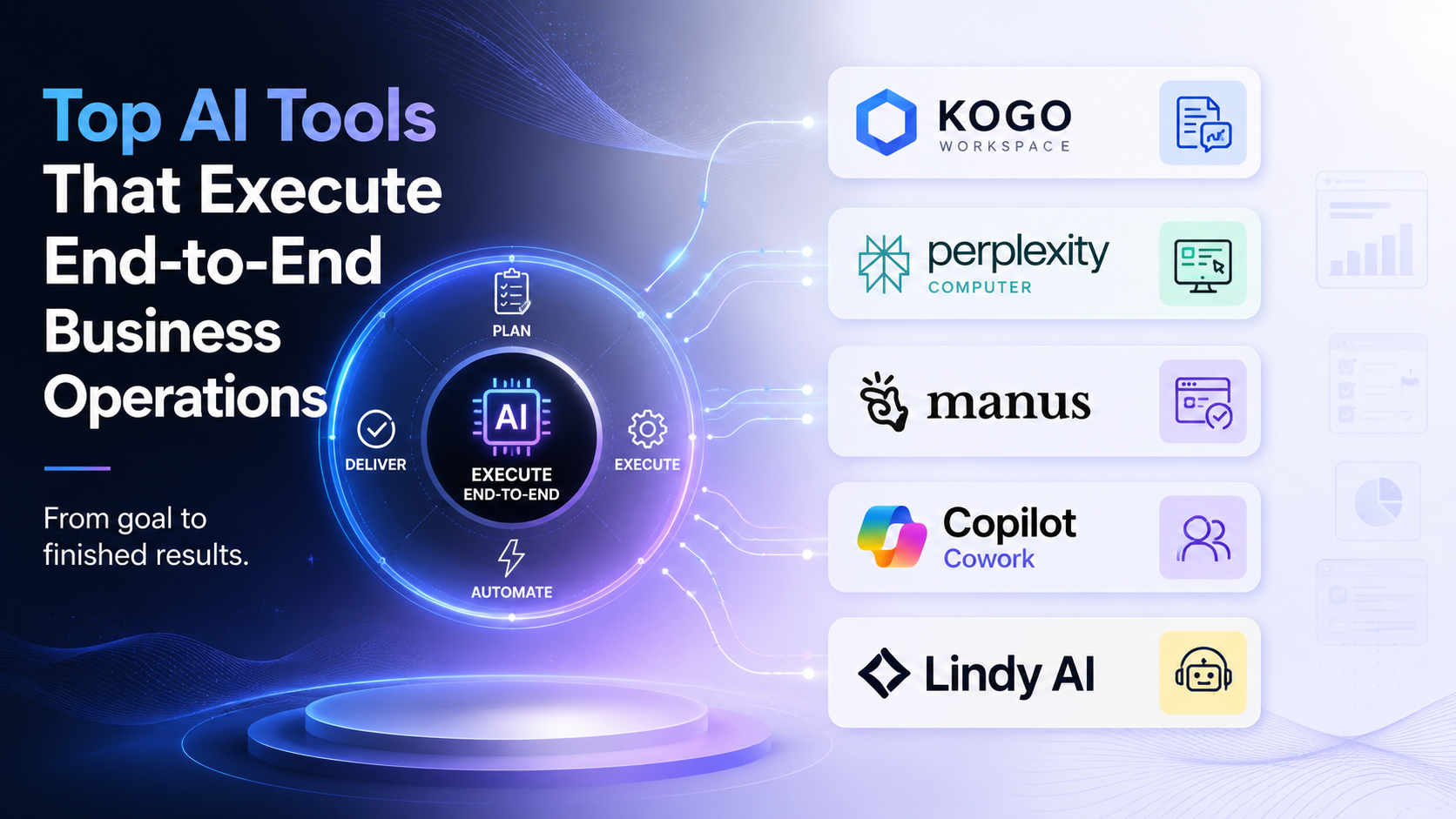
The buzz around Fable 5 has only reinforced how far AI has come in tackling complex reasoning, software engineering, research and other long running tasks. But a powerful model alone doesn’t complete business operations. Enterprises need AI that can turn those capabilities into finished work by planning, executing and coordinating tasks across applications and data sources. Here are five AI tools that take that vision a step further by helping businesses automate end-to-end operations.
- KOGO
KOGO Workspace can privately run an entire business, function, teams and processes in a single interface controlled by humans. It runs on KOGO OS, a full-stack private agentic operating system. It supports over 200 foundational models, open-source or proprietary, giving enterprises the flexibility to work with whatever model best suits each task without being locked to a single provider. The platform deploys on cloud, on-premise, VPC, or fully air-gapped environments. Customers like Tech Mahindra and Michelin are already running it in production.
Users can ask KOGO workspace to carry out any task; it will learn the skills, if need be and execute the task with minimal human intervention. It also supports running multiple tasks simultaneously, allowing users to hand off time-consuming work while focusing on higher-value activities. What sets KOGO apart is the collaborative architecture that allows context, files, skills, tools, and teams to live in a single shared window. An employee’s institutional memory doesn’t disappear when a session ends. Rather, it compounds, with the platform learning from every interaction and retaining that intelligence inside the enterprise permanently, making usage easier for users. Their Agentic App Store adds pre-built apps across marketing, finance, HR, operations, and sales that teams can configure and run without any engineering. KOGO also has a built-in red teaming module that actively simulates adversarial attacks against deployed agents, which is rare among commercial agentic platforms.
- Perplexity Computer
Perplexity Computer helps businesses run by taking end-to-end tasks and executing them reliably across the software stack the company already uses. When an employee gives it a task, it breaks the goal into smaller steps, uses the right apps and data sources, and returns work that is close to finished and ready for human review. That cuts down on switching between tabs and tools, removes repetitive manual work, and keeps things moving even when the team is busy.
Because it runs multi-step workflows and connects to existing apps, Computer is especially valuable for tasks that require orchestration rather than a single answer. It can run for hours or days, monitor progress, and adapt when inputs change so teams get continuity and fewer manual handoffs. Security and enterprise controls let larger organizations restrict access, audit actions, and integrate with internal data stores so automation scales without exposing sensitive information. It reduces busywork, improves consistency, and frees skilled employees to focus on judgment, creativity, and strategy rather than routine execution.
- Manus
Manus is a fully autonomous AI agent designed to work as a digital executor that takes projects from concept to completion. Rather than just providing text-based answers, it uses a built-in browser and a secure computing environment to interact with the real world and execute complex, multi-step workflows. Users can give it a broad objective like building a custom website, analyzing financial data from various live sources, or managing a cross-platform content schedule and it will handle the research, tool use, and implementation on its own.
The platform is particularly effective at bridging the gap between different technical tasks, from writing and deploying code to generating professional-grade media assets. It can navigate the web to find information, use a shell to process data, and even handle transactions or account management within a browser. For a business, this means the ability to scale operations without adding overhead; it can automate the manual “grunt work” of data entry, research, and technical setup that usually slows down a team. By acting as an independent digital workforce, Manus allows users to offload the execution of repetitive or technical tasks so they can stay focused on the creative and strategic parts of their business.
- Copilot Cowork
Copilot Cowork is Microsoft’s AI execution layer for Microsoft 365. Instead of asking users to jump between Outlook, Teams, Word, Excel and SharePoint, it works across these applications to complete tasks from start to finish. A user simply describes the outcome they want, and Copilot Cowork figures out the steps, gathers relevant information from emails, meetings, documents and business data, then produces the final output. Whether it’s preparing a customer briefing, creating a presentation or coordinating a meeting, it handles much of the work behind the scenes while keeping the user informed at key stages.
What sets Copilot Cowork apart is its close integration with an organisation’s Microsoft environment. It understands the context stored across Microsoft 365, follows existing security and compliance policies, and can work with built-in or custom business workflows. Rather than acting as a general-purpose AI assistant, it’s designed to automate everyday enterprise work by connecting people, data and applications in a single workflow, while allowing users to review and approve important actions before they’re carried out.
- Lindy AI
Lindy AI is designed around the idea of AI employees that can take over routine business functions. Instead of creating a single assistant, users build specialized AI agents for roles such as executive assistants, sales representatives, recruiters, customer support agents or operations managers. Each agent can communicate with business applications, retrieve information, make decisions based on predefined rules and complete tasks without requiring constant prompts from the user.
The platform comes with hundreds of prebuilt templates for common business workflows, allowing teams to automate everything from scheduling meetings and qualifying leads to updating CRM records, responding to customer inquiries and processing internal requests. By combining multiple AI employees into a single workflow, Lindy helps organizations automate repetitive business processes while allowing humans to step in only when approvals or exceptions are required.