



Union Minister for Electronics and Information Technology, Ashwini Vaishnaw, announced on September 16 that some of the world’s most advanced chips, used in AI servers, drones, and mobile phones, will now be designed in India. ARM’s newly inaugurated Bengaluru unit will focus on developing cutting-edge 2-nanometer chips, marking a significant step for India’s semiconductor ambitions.
Speaking at the launch of ARM’s new office,Ashwini Vaishnaw, highlighted the strategic importance of the move. “ARM will be designing even two-nanometer chips here in Bengaluru. Congratulations to ARM and their entire team,” he said. This development signals India’s growing role in the global semiconductor design landscape.
Since the launch of India’s Semiconductor Mission in January 2022, the country has made substantial progress in building a robust semiconductor ecosystem. Currently, 10 semiconductor units are under construction, including two fabrication facilities (fabs) and eight outsourced semiconductor assembly and test (OSAT) units. Among these, CG Semi has already started pilot production, while two more units are expected to begin pilot operations shortly.
Vaishnaw also emphasized that India is attracting the full supply chain required for chip manufacturing. From essential chemicals to specialized gases and substrates, ecosystem partners are increasingly establishing facilities in the country. “Whether it’s the 500-plus chemicals or 50-odd gases needed for fabrication, they are all coming to India. Substrate manufacturers have also set up operations, and the ecosystem is taking shape,” he said.
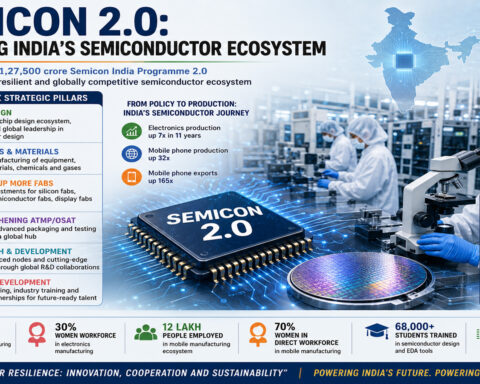
Looking ahead, the minister outlined the roadmap for Semiconductor Mission 2.0, which will go beyond chip production to include the manufacturing of semiconductor equipment and materials. “The next phase will focus on the entire semiconductor stack—chip design, chip manufacturing, the equipment that produces chips, the materials used in chip production, and building a complete talent pipeline,” Vaishnaw explained.
With these initiatives, India aims to emerge as a global hub for advanced semiconductor design and manufacturing, supporting the country’s technology ambitions and positioning it as a key player in the global semiconductor ecosystem.