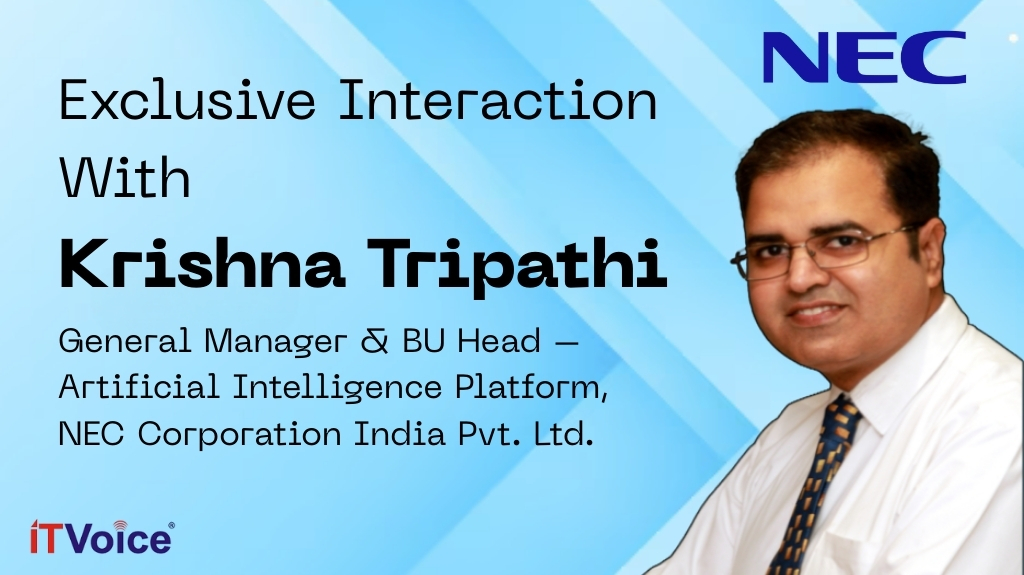
In an Exclusive Interaction With , Krishna Tripathi, General Manager & BU Head – Artificial Intelligence Platform at NEC India, shares insights on how AI, ML, and Generative AI are shaping citizen services, enterprises, and India’s digital future. From smart cities to financial inclusion, his journey reflects a people-first approach to technology with global benchmarks in innovation.
IT Voice- Having led NEC India for over a decade, how has your journey influenced the company’s AI and digital transformation roadmap?
Over the years, my journey at NEC India has been driven by one fundamental belief: technology must serve a real purpose. In leading the AI business, we’ve aligned NEC’s global strengths with India’s priorities—across governance, financial inclusion, healthcare, and infrastructure. Our approach is rooted in building AI solutions that are not only technically advanced but also regulatory-compliant, scalable, and tailored to local needs. From transforming public sector platforms like the National Pension System to delivering data-driven solutions for major banks, every deployment reflects a long-term vision of impact.
At the heart of our AI roadmap is a broader ecosystem of technologies—IoT, data analytics, edge computing, and cloud infrastructure—that amplify the power of artificial intelligence. For instance, by integrating IoT sensors with AI algorithms, we’ve enabled real-time insights for urban mobility, utilities, and public safety. Our advanced analytics platforms help institutions move from reactive to predictive models, improving operational efficiency and decision-making. These layers of intelligence are what make our AI solutions more adaptive, responsive, and impactful.
The digital transformation roadmap at NEC India is not a linear journey—it’s a living blueprint that evolves with emerging technologies and changing citizen needs. By aligning NEC’s global capabilities with India’s development priorities, we’ve created platforms that are not only technologically advanced but also deeply embedded in the country’s socio-economic fabric.
IT Voice- NEC is known globally for advanced technology. How is NEC India applying AI/ML and Generative AI to transform public services and enterprises?
At NEC India, AI/ML and Generative AI are not seen as isolated technologies but as foundational enablers of systemic transformation. Our work spans critical domains—ranging from public infrastructure and citizen services to enterprise operations across BFSI, manufacturing, and smart cities.A notable example is the deployment of AI-powered Integrated Command and Control Centers (ICCCs) in cities such as Thiruvananthapuram, Saharanpur, and Meerut. These centers consolidate live data streams from traffic signals, surveillance systems, waste management, and emergency services to deliver predictive insights, real-time alerts, and faster municipal response. By using AI for anomaly detection and decision intelligence, these platforms improve service delivery and safety at scale.
In the banking space, we’re leveraging AI for fraud prevention, claims automation, and customer personalization. Our Identity Fraud Detection and PII Redaction tools are already being used by leading banks and insurers to ensure compliance and reduce risks while delivering faster, more secure services.
We’ve also applied Generative AI to enhance e-governance platforms. For instance, our NLP-powered solution for a large e-Marketplace allows smarter search, intelligent product discovery, and contextual recommendations—streamlining procurement for thousands of government departments.
These are not just digital upgrades; they represent a shift toward smarter, citizen-centric ecosystems.
IT Voice- Could you share some impactful AI and Generative AI use cases in India that have directly improved the lives of citizens and strengthened society?
At NEC India, we design AI solutions with a clear people-first lens. One of the most impactful projects has been with the Uttar Pradesh State Road Transport Corporation (UPSRTC). By integrating AI-powered vehicle tracking, emergency response systems, and a centralized command center, we’ve significantly improved commuter safety, incident management, and fleet efficiency across a vast public transport network.
In urban governance, our AI-powered ICCCs support predictive policing, traffic decongestion, and faster emergency responses—creating safer, more responsive cities. These platforms are designed to be inclusive, scalable, and interoperable with existing urban infrastructure
These solutions are not just technological milestones, they represent how AI can build trust, accessibility, and dignity into public services. By anchoring innovation in the realities of citizen’s daily lives, we’re ensuring that technology uplifts, protects, and empowers.
IT Voice- Beyond India, what global AI implementations by NEC stand out as benchmarks for innovation?
NEC’s approach to artificial intelligence is grounded in solving real-world problems with precision, creativity, and responsibility. Globally, NEC has delivered AI solutions that not only meet complex enterprise demands but also address critical societal challenges with measurable impact. A notable example is NEC’s collaboration with Lockheed Martin on NASA’s Orion spacecraft, where its System Invariant Analysis Technology (SIAT) processes millions of sensor data points in real time to predict potential failures, significantly enhancing mission safety. This human-AI partnership exemplifies cutting-edge innovation in high-stakes environments.
Another landmark project is NEC’s partnership with Chugai Pharmaceutical, where graph-based AI models accelerate the prediction of effective drug combinations—halving research time while maintaining transparency and explainability. NEC’s CropScope platform leverages satellite and soil data integration to drive precision in agricultural practices. Additionally, in Japan, NEC collaborated with Kagome to develop AI-designed vegetable-based puddings, which have been widely accepted by children, promoting healthier eating habits. These diverse initiatives illustrate NEC’s unwavering commitment to responsible AI innovation that delivers tangible benefits to society at large.
IT Voice- Looking ahead, what key trends will shape India’s AI and digital transformation journey over the next three to five years?
Over the next three to five years, the AI and digital transformation landscape in India is set to evolve rapidly, driven by advancements in generative AI, automation, and data-driven decision-making. Organizations will increasingly leverage AI not just as a tool for efficiency, but as a strategic driver of innovation, helping them anticipate trends, optimize operations, and create new value streams. We can expect a deeper integration of AI with cloud platforms, IoT, and advanced analytics, creating intelligent ecosystems that are adaptive, scalable, and more resilient.
This shift will also be accompanied by a stronger focus on data governance, security, and ethical frameworks, ensuring responsible adoption. Another significant trend will be the democratization of AI, where accessible platforms and tools enable businesses of all sizes to harness AI capabilities without heavy infrastructure investments. This, combined with upskilling initiatives, will empower talent to work alongside AI, fostering a culture of continuous innovation. Finally, the pace of digital transformation will be accelerated by collaborations between enterprises, startups, and government bodies, creating an environment where technology and policy evolve hand in hand. The result will be an ecosystem where AI and digital tools are not just enablers but integral to shaping smarter, more responsive, and future-ready organizations.