

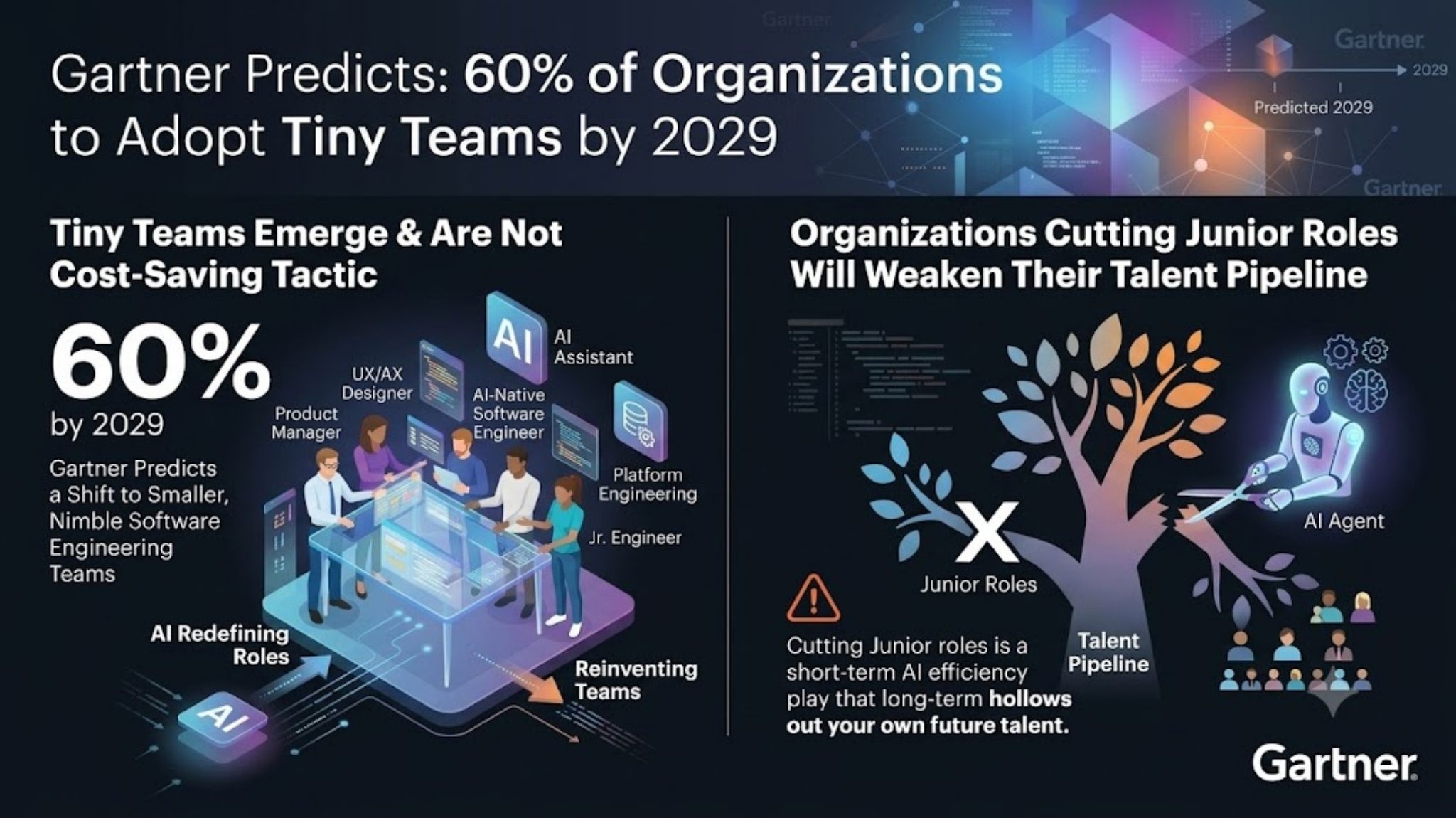
By 2029, 60% of organizations will adopt smaller software engineering teams at scale, up from 15% in 2026, according to Gartner, Inc., a business and technology insights company.
“AI is reshaping software engineering. It is redefining roles, reinventing teams, and fueling the demand for more software engineers, not fewer,” said Aliyah Camacho, Principal Analyst at Gartner. “The resources required to meet the growing demand for software and complex AI-enabled applications will outpace the efficiency gains from AI.”
Tiny Teams Are Not a Cost-Saving Tactic
As AI handles more routine technical tasks, it frees up engineers to focus on complex problem-solving and innovation, enabling the emergence of “tiny teams.” “Tiny teams are not a cost optimization tactic,” said Camacho. “This is a restructuring of teams to best take advantage of both human and AI capabilities and strengths.”
The exact size of tiny teams will vary by organization and the needs of the feature set or product they are developing. “Today’s tiny teams typically have 4–5 members, but some require as few as 2–3, which will become more common as employee skills and AI capabilities mature,” said Camacho. “Most importantly, tiny teams should be small enough to stay nimble and effective, and big enough to promote diversity of ideas or alternate viewpoints.”
As tiny teams are supported by robust platform engineering teams, they can focus on high-value work by providing standardized, automated workflows and self-service AI tools and capabilities.
Tiny Teams Should Still Include Junior Talent
Tiny teams require versatile and skilled engineers such as a product manager, a user experience (UX)/agent experience (AX) designer, and at least one AI-native software engineer. However, software engineering leaders should not stop hiring and developing junior-level talent.
In a tiny team, traditional software engineering role boundaries collapse, as each team member manages a variety of responsibilities, from understanding business goals to product design and overseeing AI agents.
“Slowing junior-level hiring could lead to significant pitfalls, including inhibiting knowledge transfer, restricting the internal talent pipeline, and limiting recruitment to more expensive and competitive senior roles,” said Camacho.
Gartner predicts that by 2028, organizations that rely on AI to cut junior roles will hollow out their own software engineering talent pipeline.
Additional Insights Available
Gartner clients can read more in How To Structure AI-Native, Software Engineering Tiny Teams and Future of Software Engineering 2030: AI-Native Tiny Teams. Learn how software development teams compare to others in the Gartner Software Engineering Score.