
For most organizations planning to build a Security Operations Center (SOC), the question is no longer whether to invest, but what it will take to make it operational. While many companies expect to launch an SOC within a year and to keep their budgets under control, real-world experiences differ significantly, shaped by variations in scale, maturity, and strategic priorities.
As Kaspersky has highlighted in its previous stories, many organizations are planning to build a Security Operations Center (SOC) to strengthen their overall security posture. These findings, based on Kaspersky’s comprehensive global study, reveal that behind seemingly similar plans, companies face very different realities when turning SOC concepts into operational capabilities.
According to the study, the average planned budget for setting up a SOC globally is around 2 million USD. However, this figure conceals significant variations in expectation levels.
In India, the majority of the organizations (91%) plan budgets below 1 million USD. The rest of the respondents allot varying budgets for SOC, from more than 1 million USD up to 5 million USD. On average, companies here allocate 3.5 million USD to implement their SOC.
Globally, planned spending strongly correlates with company size and their level of SOC outsourcing, as smaller companies tend to focus on more modest investments, whereas large organizations are far more likely to plan costly SOC projects, reflecting broader infrastructure coverage and higher operational demands.
Notable state-level differences were also revealed, as organizations in countries like Vietnam and China were willing to invest more than the global market average in SOC development, whilst many other nations were not inclined to spend more than 1 million USD. The shift towards an increasing SOC budget may be explained by the countries’ strategic focus on digital sovereignty and the development of in-house security solutions within national infrastructure.
“Cyberthreats in India are growing in both volume and sophistication, driven by rapid digitalisation and the expansion of critical infrastructure in the country. Now, the challenge in establishing a SOC is not just budget or technology in isolation, it is complexity. Leaders are under pressure to justify investment with measurable outcomes, integrate multiple security layers, and build processes that can scale. For Indian businesses operating in high-growth, high-risk digital environments, the real differentiator will be discipline, clear metrics, integrated architecture, and the right mix of expertise to turn security operations into a strategic advantage rather than a cost center, comments Jaydeep Singh, General Manager for India, Kaspersky.
When it comes to timelines, expectations were similarly concentrated, but with notable outliers. Two-thirds of companies in India (67%) expect to build their SOC within 6-12 months, while one quarter (31%) anticipate longer projects lasting up to two years.
Globally, despite operating in more complex environments, large companies are more likely than mid-sized organizations to prioritize faster SOC deployment. In practice, this often means launching an SOC for critical segments first and then expanding coverage across the infrastructure in stages.
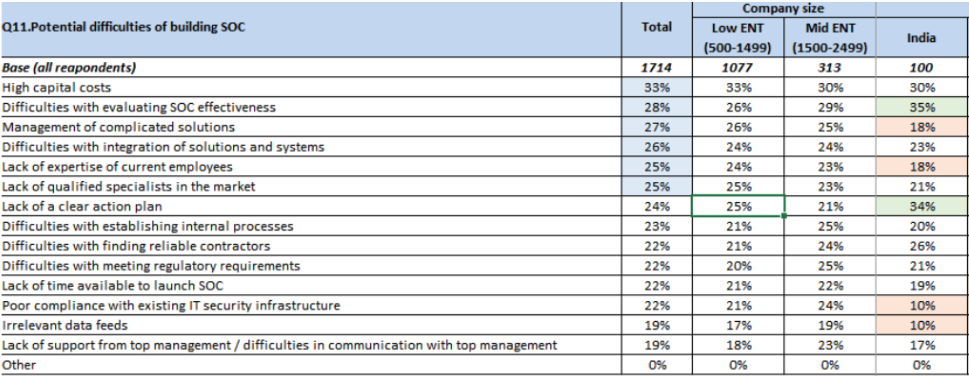 The research also highlights that building a SOC comes with a wide range of challenges rather than a single dominant obstacle. Evaluating SOC effectiveness (35%) was cited by Indian respondents most frequently by one third of respondents (35%). This often involves a wide range of KPIs, from financial metrics like Return on Investment (ROI) and operational benchmarks such as Mean Time to Detect (MTTD) and Mean Time to Response (MTTR), to strategic objectives like ensuring compliance with industry standards.
At the same time, many companies here struggle with high capital costs (30%) and find integration of multiple solutions and systems difficult (23%). More than a quarter of companies also underline that human resource remains a critical constraint alongside technology and budgets. Nearly 1 in every 3 Indian organizations also point to a lack of external labor market (21%) and even in the expertise among existing employees (18%).
Additionally, firms aiming to establish a SOC here grapple with a lack of a clear action plan (34%), difficulties in establishing internal processes (20%), and managing complex security solutions (18%).
“Based on our research results for APAC, it is clear that the conversation around SOCs has shifted from ‘how do we build one?’ to ‘how do we prove it truly delivers value?’ The challenge in establishing SOC here is not just budget or technology in isolation, it is complexity,” comments Adrian Hia, Managing Director for Asia Pacific at Kaspersky. “Leaders are under pressure to justify investment with measurable outcomes, integrate multiple security layers into a coherent operation, and build processes that can actually scale. At the same time, the talent gap remains a structural constraint, making operational excellence harder to achieve than strategic intent. For APAC businesses operating in high-growth, high-risk digital environments, the real differentiator will be discipline: clear metrics, integrated architecture, and the right mix of expertise to turn security operations into a strategic advantage rather than a cost center.”
To successfully build and operate a reliable SOC, Kaspersky recommends to apply the following products and services:
- Engage with Kaspersky SOC Consulting during the initial setup or when enhancing your existing security operations. Our comprehensive consulting services are designed to help companies build a robust SOC and streamline its processes.
- Boost your security performance with Kaspersky SIEM, powered by advanced AI capabilities. This solution aggregates, analyzes and stores log data across your entire IT infrastructure, providing contextual enrichment and actionable threat intelligence insights.
- Protect your company against a wide range of threats with solutions from the Kaspersky Next product line that provide real-time protection, threat visibility and AI-driven investigation and response capabilities of EDR and XDR for organizations of any size and industry.
- Equip your cybersecurity team with in-depth visibility into cyber threats targeting your organization. The latest Kaspersky Threat Intelligence delivers rich, contextual insights throughout the entire incident management cycle, enabling timely identification of cyber risks.
- If you lack dedicated personnel to perform key SOC functions, use Kaspersky Managed Detection and Response and Kaspersky Incident Response. These services cover the entire incident management cycle – from threat identification to continuous protection and remediation. They help to protect against evasive cyberattacks, investigate incidents and get additional expertise.
To explore more of Kaspersky’s solutions and services for building and enhancing your SOC, please follow this link.