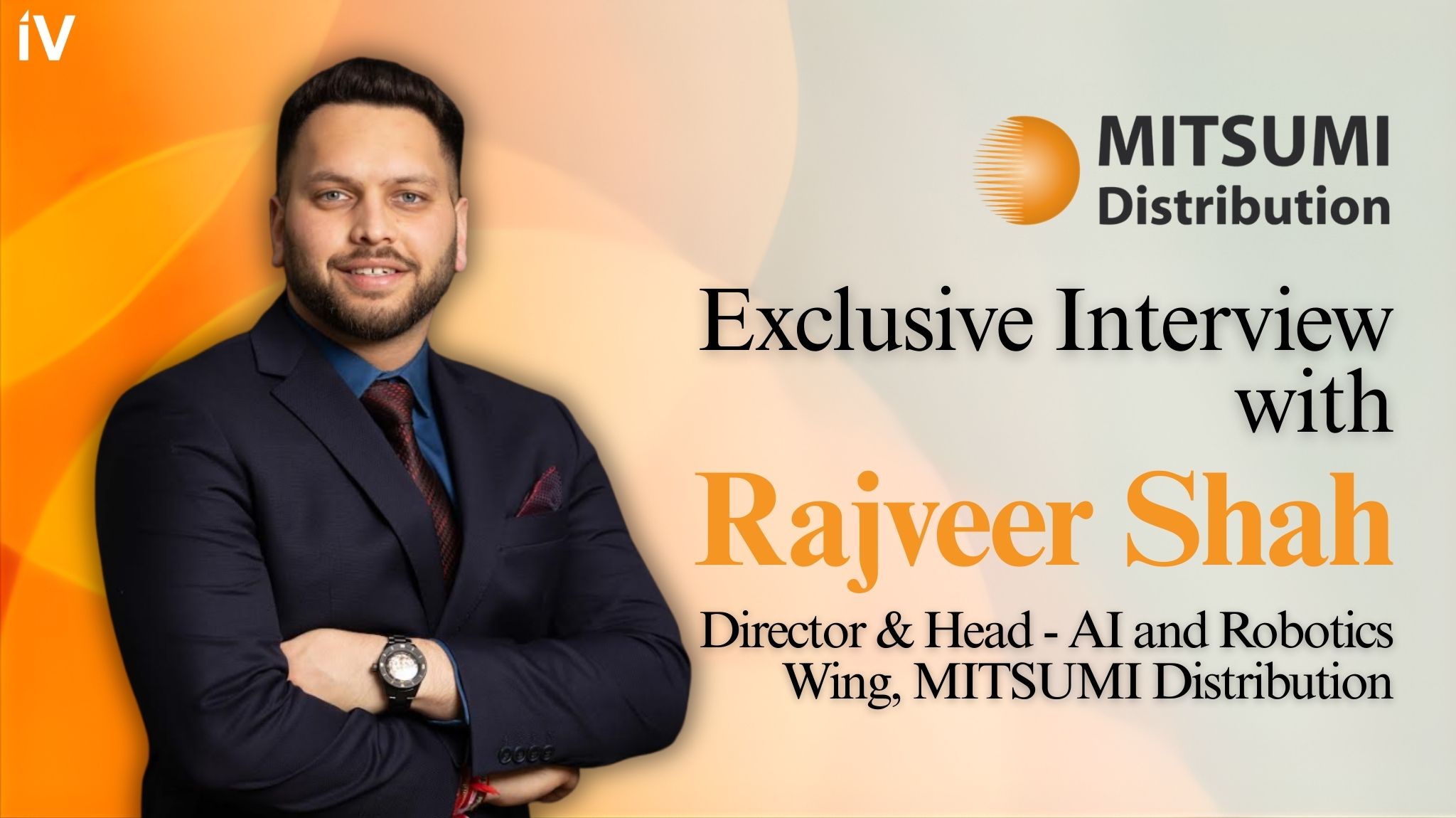
Rajveer Shah- The role of a distributor has fundamentally changed. For years, the measure of success was speed and volume: how quickly you could move product from point A to point B. AI has turned that baseline expectation into the bare minimum. What it enables now is something far more meaningful: the ability to anticipate, consult, and co-create value with partners and end customers.
At MITSUMI, we made a conscious decision to move beyond being a traditional distributor toward becoming a value-added ecosystem enabler, and AI is central to that shift. We have a dedicated team that works closely with partners and end customers to understand their specific use cases and align the right technology solutions to their business needs. That consultative depth is what separates a strategic ecosystem partner from a logistics intermediary. When your role is to assess a partner’s readiness before recommending a solution, you’re no longer just in the supply chain business, you’re in the business of enabling transformation.
IT Voice– Can you share examples of how AI tools are enabling partners to move beyond product reselling toward solution-led engagements?
Rajveer Shah- Healthcare is a good example of how this shift looks in practice. Working with select vendor partners, we ran AI-focused workshops in Nairobi with decision-makers from institutions such as Kenyatta National Hospital and Nairobi Hospital. The discussions centred on practical applications, how AI can support disease detection, streamline clinical workflows, and improve patient care. For partners who attended, it helped reframe how they engage with customers, moving the conversation from products to outcomes.
In telecom, partners are moving into conversations around network optimisation, predictive maintenance, fraud detection, and increasingly, 5G readiness. Rather than simply supplying network equipment, a partner backed by the right AI frameworks can help an operator continuously optimise network parameters for performance and capacity, use machine learning to flag potential equipment failures before they affect service quality, or apply customer analytics to identify churn risk and personalise services. With 5G rollouts progressing across many of our markets, there is also growing demand for solutions around network slicing and edge computing: areas where an informed partner can add real advisory value.
In manufacturing, the entry point is typically around production and supply chain efficiency. AI can optimise production sequences, enable dynamic resource allocation, and support real-time schedule adjustments. On the inventory side, machine learning models improve demand forecasting, automate reorder triggers, and help reduce carrying costs. Logistics within manufacturing operations also benefit, from route optimisation and warehouse automation to supplier performance prediction. These are outcome-driven conversations that go well beyond supplying hardware.
What makes this possible is a structured approach to enabling our partners across the full solution lifecycle, from initial assessment and discovery, through solution design and architecture, to proposal development, service delivery, and ongoing customer success. We also provide access to GenAI platforms and business intelligence tools, alongside vertical-specific solution frameworks tailored to sectors like healthcare, telecom, and manufacturing. Training and enablement are built into this model, ensuring partners are equipped to deliver, not just sell. The goal is to give partners a credible, end-to-end capability so that the conversation with a customer can go as deep as the customer needs it to.
IT Voice– How do you see AI levelling the playing field for partners in Tier 2 and Tier 3 markets, especially in emerging economies like India?
Rajveer Shah- India is an exciting inflection point for us. MITSUMI has just made a long-term strategic commitment to the Indian market, with offices in Mumbai, Delhi, and Bengaluru, and an investment commitment of ₹700–1,000 crore over the next three years. And the reason India makes sense for us right now is precisely because of what AI represents for markets beyond the metros.
What we’ve learned across Africa (where we operate in 36 countries, many of them with significant technology gaps) is directly applicable here. Partners in emerging markets have historically been locked out of enterprise-level conversations because they lacked the technical depth to compete. When we provide a Tier 2 or Tier 3 partner with AI tools, pre-built use-case frameworks, and vendor-certified training, it reduces the barrier to entry considerably. They can build on existing frameworks and expertise rather than starting from scratch. Our model is built on making technology accessible, affordable, and actionable, the same philosophy that drove us to work with microfinance firms in Africa to enable device financing. In India, that same thinking applies to how we engage partners in smaller markets who deserve the same quality of support as those in the largest cities.
IT Voice– How is MITSUMI Distribution embedding AI into logistics optimization to enhance operational efficiency and service precision?
Rajveer Shah- We apply the same thinking internally that we advocate to our partners. Across our operations, we have been integrating AI tools to support better decision-making, particularly around inventory management, demand forecasting, and responding to shifts in market demand.
Our 100,000 sq. ft. logistics hub in Jebel Ali, Dubai, is the central point of our supply chain. Operating across 36 markets means dealing with currency variability, differing regulatory environments, and varied last-mile conditions. AI helps us manage that complexity, improving how we plan stock movement, anticipate demand, and respond when conditions change, so that our in-country teams are working with current, reliable information rather than reacting after the fact.
In India, where we are establishing a network of 14 warehouses across the country, this becomes even more important. India’s scale and diversity, in geography, infrastructure, and market maturity, means that a one-size-fits-all logistics model will not work. Embedding AI into our warehouse and distribution operations from the outset will allow our teams to process data faster, identify patterns specific to each region, and make more informed decisions on the ground.
The underlying goal across all our markets is consistency: ensuring that a partner in Lagos, Nairobi, or Bengaluru receives the same standard of service reliability, regardless of the operational complexity involved.
IT Voice– As AI becomes central to business operations, how important is it for organizations to build trust in AI frameworks?
Rajveer Shah- It is foundational, and in my experience, one of the more underestimated dimensions of AI adoption. Technology is only as powerful as the trust placed in it. We saw this firsthand when we started engaging healthcare institutions with AI solutions. The questions weren’t just about capability; they were about data privacy, accountability, and what happens when an AI recommendation is wrong. Those are not technical questions, they are trust questions.
In Africa, we often say that trust is not cheap. It comes after years of consistent partnership and delivery. The same principle applies to AI. Organizations that deploy AI without establishing clear governance frameworks, explainability standards, and accountability structures will face serious resistance and rightly so. At MITSUMI, our approach is always to walk customers through real use cases, demonstrate outcomes in transparent ways, and support them with the human expertise: data scientists, engineers, solution architects, who can explain and validate what the AI is doing. Trust in AI isn’t built through marketing; it’s built through demonstrated, responsible deployment.
IT Voice– What advice would you give global enterprises looking to integrate AI while ensuring accountability and long-term value creation?
Rajveer Shah- The first thing I would say is: start with purpose, not technology. Many enterprises move into AI because there is pressure to be seen doing something with it, rather than because they have identified a specific problem they want to solve. That approach tends to produce activity without impact. AI needs to be anchored in a clear business objective to deliver real value.
The second consideration is data readiness. A significant part of the work we do with customers involves helping them understand that an AI model is only as reliable as the data behind it. Incomplete, inconsistent, or poorly structured data leads to unreliable outputs and in sectors like healthcare or finance, that is not a risk worth taking. Getting the data foundation right is not a preliminary step; it is the work.
Third, skills need to keep pace with technology. Deploying an AI system and walking away does not work. Enterprises need people internally who can interpret outputs, identify when something is going wrong, and evolve the system as the business changes. That human layer is what makes AI sustainable over time.
And finally, think long term. It is straightforward enough to generate a quick win with AI. What is harder, and more valuable, is building an ecosystem where accountability is clear, benefits are shared across the organisation, and the technology continues to serve the business as it scales. That requires genuine commitment, not just investment.