
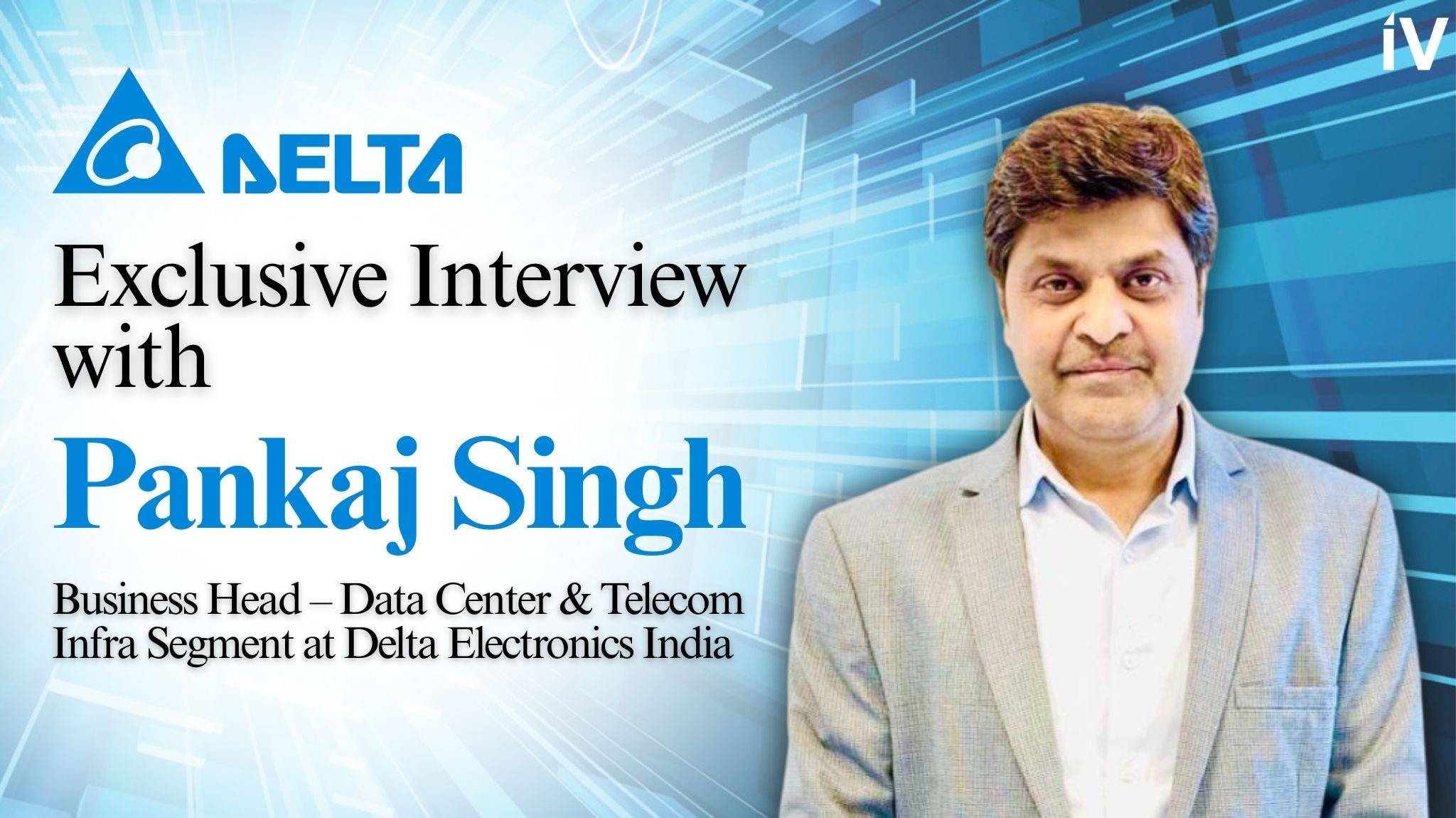
In an exclusive interview with Mr. Pankaj Singh, Business Head – Data Center & Telecom Infra Segment at Delta Electronics India, we explore how AI-driven workloads are reshaping power and cooling strategies across India’s digital infrastructure landscape. He shares insights on liquid cooling innovation, hyperscale-ready architectures, and Delta’s roadmap for scalable, sustainable data center growth by 2026.
IT Voice– As we look toward 2026, what are your top strategic priorities for Delta Electronics India’s Data Center and Telecom business?
Pankaj Singh- As we look ahead to 2026, our strategic priorities are shaped by one clear reality: digital infrastructure is being redefined by AI, density, and energy intensity. Our focus is on ensuring that our portfolio is fully aligned for AI-ready, high-density deployments, where traditional assumptions around power distribution and cooling no longer apply.
We are approaching infrastructure planning from a power-first perspective. This means thinking holistically about UPS systems, energy storage, grid interface, and how power behaves under rapidly fluctuating AI loads. In parallel, we are moving decisively away from point solutions. Customers today are not looking for isolated products; they want integrated power, cooling, and control systems that are designed to work together as a single architecture.
A critical part of this strategy is our focus on liquid cooling, particularly direct-to-chip liquid cooling architectures supported by a robust Secondary Fluid Network (SFN). SFN enables efficient heat rejection, scalability, and repeatability—key requirements for hyperscale and modular data center builds. Ultimately, our priority is to design solutions that are not only high-performance, but also repeatable, scalable, and ready for rapid deployment across multiple sites.
IT Voice– How do you see India’s data center and telecom infrastructure market evolving over the next 12–18 months?
Pankaj Singh- Over the next 12–18 months, we expect the Indian market to shift from a capacity-led growth phase to one that is clearly power- and thermal-led. The rise of GPU-driven AI workloads is fundamentally changing how data centers are designed, built, and operated. It is no longer sufficient to think in terms of megawatts alone; the challenge is managing heat concentration at unprecedented levels.
At the same time, customers are placing much higher expectations on deployment speed, standardisation, and predictability. Hyperscalers, in particular, want designs that can be replicated quickly with minimal variation. Alongside this, there is increasing scrutiny on PUE, overall energy intensity, and the impact on the grid, especially as AI loads place new demands on power infrastructure.
Encouragingly, the ecosystem in India is evolving. We are seeing the emergence of a more established supply chain around Secondary Fluid Networks, which is essential for scaling liquid-cooled data centers reliably. This maturity will play a key role in enabling the next phase of growth.
IT Voice– Which growth segments will drive your expansion plans in 2026?
Pankaj Singh- Our expansion strategy is multi-pronged, reflecting the diverse nature of demand across segments.
Hyperscalers will continue to be a major growth driver. Their focus is on repeatable architectures and liquid-ready designs that can support high-density AI deployments at scale. Consistency, reliability, and speed of rollout are critical here.
Edge data centers are another important segment. These require compact, low-maintenance power and cooling blocks that can operate reliably in distributed environments with limited onsite intervention.
For enterprises, the focus is increasingly on hybrid IT environments, including retrofits and brownfield upgrades. These customers are looking to improve efficiency, extend asset life, and support higher densities within existing footprints.
In telecom, ongoing 5G densification is driving demand for solutions that deliver energy efficiency and reliability at distributed sites, where operating conditions can vary widely.
IT Voice– What key innovations or new solutions is Delta planning to introduce to support next-generation digital infrastructure?
Pankaj Singh- Our innovation roadmap is driven by the realities of next-generation workloads. We are advancing high-efficiency air cooling solutions, tightly integrated with direct-to-chip liquid cooling to support higher rack densities.
A significant area of development is liquid-to-liquid cooling, which, when combined with a well-designed Secondary Fluid Network, allows for more efficient heat transfer and greater flexibility in system design. These approaches are particularly relevant for AI-heavy environments.
We are also developing modular cooling units engineered specifically for high-density deployments. On the power side, systems are being designed to handle fast load changes, which are characteristic of AI workloads.
Equally important is intelligence. By integrating monitoring, controls, and predictive diagnostics, we enable operators to optimise performance, anticipate issues, and improve long-term reliability.
IT Voice– How are AI-driven workloads and edge computing reshaping demand for power and cooling?
Pankaj Singh- AI workloads are reshaping infrastructure requirements in fundamental ways. The most significant change is the rapid rise in thermal concentration, rather than just total load. This is driving a shift in cooling design closer to the chip level, as traditional room-based cooling approaches become less effective.
Power delivery must also evolve. AI environments demand highly precise power delivery, fast response times, and robust redundancy to maintain uptime under dynamic conditions.
At the edge, requirements are different but equally challenging. Edge computing environments require simplified, autonomous infrastructure that can operate reliably with minimal maintenance, while still delivering efficiency and resilience.
IT Voice– Sustainability is a major focus globally—how is Delta integrating green technologies into its offerings?
Pankaj Singh- Sustainability is integrated into our design philosophy from the outset. Our cooling systems are engineered to minimize energy consumption per unit of compute, rather than focusing solely on absolute energy reduction.
We actively support integration with renewable energy sources and energy storage systems, enabling customers to manage energy more effectively. At the same time, we focus on reducing water usage and refrigerant dependence, particularly through advanced liquid cooling architectures and closed-loop Secondary Fluid Networks.
These approaches help customers meet ESG and regulatory requirements while maintaining high performance and reliability.
IT Voice– How are Delta’s solutions helping customers improve energy efficiency and reduce operational costs?
Pankaj Singh- Operational efficiency is achieved through architecture-level optimisation. By combining high-efficiency power systems with advanced cooling designs, customers can achieve lower PUE and better overall energy utilisation.
Smart controls play a key role, enabling cooling systems to adapt dynamically to real-time loads. Modular, serviceable designs reduce maintenance effort and downtime, lowering operational costs over the life of the facility.
In high-density, mission-critical environments, these benefits translate directly into improved uptime and reduced total cost of ownership.
IT Voice– What role do partnerships and ecosystem collaborations play in accelerating growth?
Pankaj Singh- Partnerships are central to our growth strategy. We work closely with hyperscalers and OEMs on co-engineering efforts, ensuring that solutions are validated and optimised before deployment.
We also collaborate with EPCs and system integrators to align on standardised designs. Ecosystem readiness—particularly around liquid cooling and Secondary Fluid Networks—is critical for accelerating deployment and reducing risk.
Pre-validated architectures help customers move faster while maintaining confidence in performance and reliability.
IT Voice– How is Delta strengthening its channel and system integrator ecosystem across India?
Pankaj Singh- We are investing significantly in training and enablement, particularly around high-density and liquid-cooling systems. This includes commissioning, operation, and lifecycle support.
Building strong local capabilities is essential. Partners must be equipped to handle complex, AI-driven deployments and deliver consistent execution across regions. Standard processes, shared technical frameworks, and continuous engagement ensure quality and reliability at scale.
IT Voice– How do you differentiate Delta in a competitive market?
Pankaj Singh- Our differentiation lies in our end-to-end power and thermal engineering capability. We bring proven reliability from mission-critical environments and the ability to support both air and liquid cooling strategies within a single, integrated framework.
This is reinforced by global R&D capabilities combined with strong local execution and support, enabling us to deliver consistently across diverse operating environments.
IT Voice– What does success look like for Delta’s Data Center and Telecom business by the end of 2026?
Pankaj Singh- By the end of 2026, success means being recognized for leadership in AI-ready, energy-efficient digital infrastructure. It means strong repeat deployments with hyperscale and enterprise customers, demonstrated performance in high-density environments, and sustainable, scalable growth delivered with operational excellence.