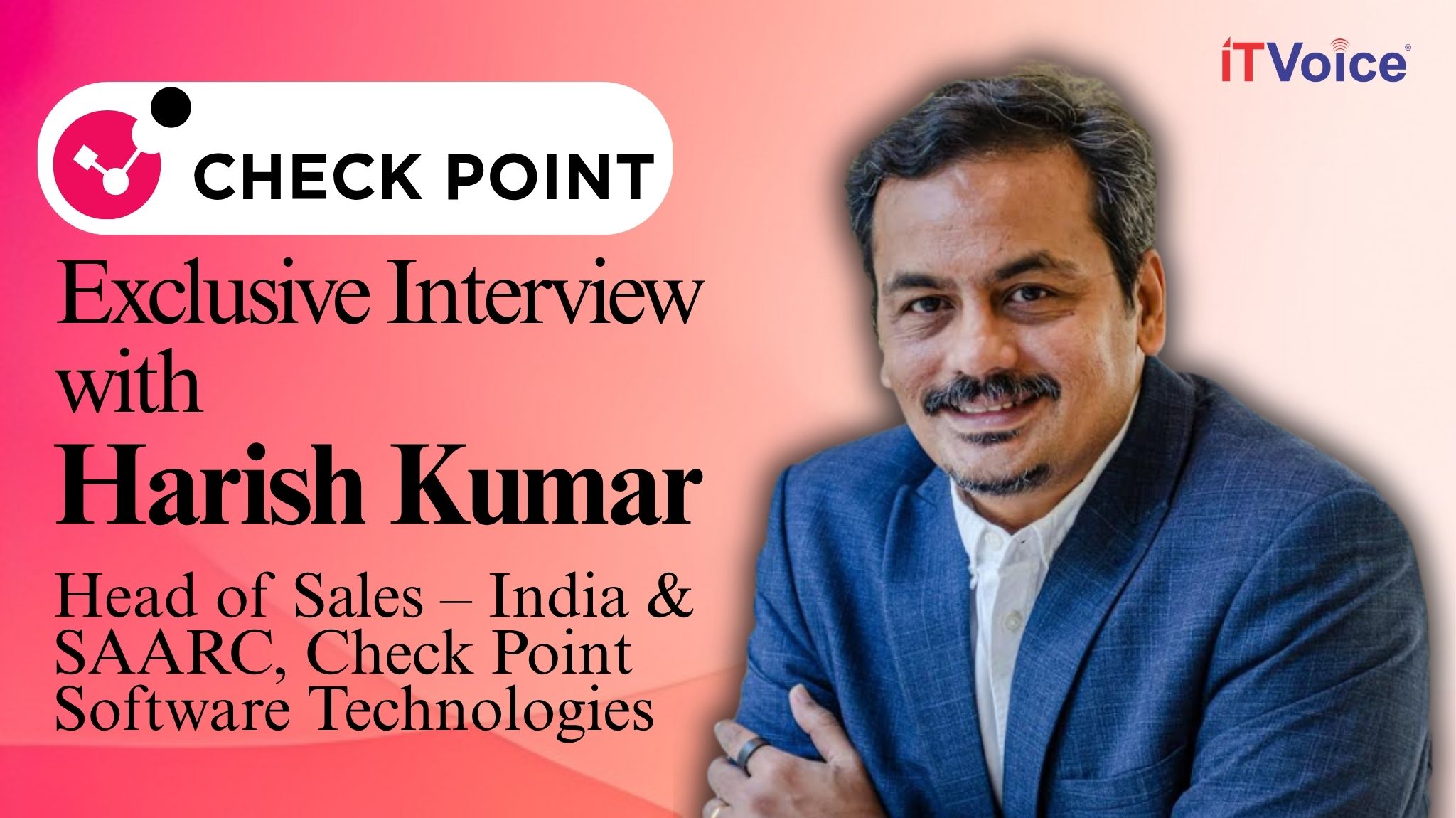
In this exclusive conversation, Mr. Harish Kumar, Head of Sales for India & SAARC at Check Point Software Technologies, discusses how AI, Zero Trust, and prevention-first architecture are reshaping cybersecurity across the region. He highlights the rising threat landscape, the growing demand across key verticals, and Check Point’s strategic focus on AI-powered innovation, partner ecosystem strengthening, and scalable security for enterprises and SMBs.
IT Voice- As the Head of Sales and GTM for India & SAARC, how do you see Check Point’s role evolving in the rapidly changing cybersecurity landscape of the region?
Harish Kumar- As threats grow more sophisticated with AI-driven attacks, ransomware, and expanding cloud and hybrid environments, our role is to help organizations stay ahead through a prevention-first, intelligence-led approach. We provide unified protection across cloud, data centers, and remote networks using solutions such as Check Point Infinity AI Copilot, the hybrid mesh security architecture, and India-based Check Point Harmony SASE. Our local R&D centre in Bengaluru develops Secure Access Service Edge capabilities tailored for Indian enterprises, enabling organizations to strengthen resilience, meet regulatory requirements, and adopt emerging technologies like AI and cloud securely. By combining global threat intelligence with local expertise and sector-specific engagement, we help enterprises safeguard operations today while preparing for future cyber challenges.
IT Voice- Cyber threats are becoming increasingly sophisticated. What are the most critical security challenges you’re seeing among Indian enterprises today?
Harish Kumar- Indian enterprises are encountering highly complex cyber threats, including AI-powered phishing, deepfake scams, ransomware, and supply chain attacks. Rapid cloud adoption, hybrid work models, and vulnerabilities in edge devices have expanded the attack surface, while fragmented security tools and limited visibility hinder timely threat detection. State-sponsored actors and professional hackers increasingly use AI to automate and scale attacks, particularly targeting education, government, healthcare, and consumer services. Organizations must adopt AI-driven threat detection, unified security platforms, advanced Security Operations Centers, and Zero Trust frameworks to maintain a real-time, prevention-first security posture and build overall resilience against evolving attacks.
IT Voice- Which key verticals in India & SAARC are currently driving the highest demand for Check Point’s security solutions?
Harish Kumar- Sectors including education, healthcare, government, construction and engineering are facing the highest intensity of cyberattacks in India, driving strong demand for advanced cyber security solutions. According to Check Point Software’s latest Threat Intelligence Report, over the last six months, organizations in India faced an average of 3,247 cyberattacks per week, nearly double the global average of 1,981, with education (7,548 attacks), government (4,809), and construction and engineering (3,872) being the most targeted. The growing adoption of digital technologies, hybrid work models, cloud services, and connected devices has widened the attack surface. Prevention first, AI powered solutions such as hybrid mesh, Check Point Harmony SASE, and AI-driven threat detection platforms developed at Check Point’s Asia Pacific R&D Centre in Bengaluru help enterprises secure critical data, ensure compliance, and future proof their defenses, making these verticals key drivers of cyber security demand across India and SAARC.
IT Voice- Check Point is known for continuous innovation in threat prevention. Could you share some insights into how emerging technologies like AI and automation are being integrated into your product portfolio?
Harish Kumar- Check Point has been integrating AI into its cyber security solutions since 2014, using it as a force multiplier to strengthen threat detection, prevention, and response for enterprises in India. Central to this is ThreatCloud AI, which powers over 55 AI engines and makes billions of security decisions daily to enable real time threat prevention at scale. Our Check Point Infinity Platform, branded as “For AI and Powered by AI,” leverages advanced machine learning and partnerships with NVIDIA and Microsoft to deliver adaptive, intelligent cyber defense.
Emerging technologies are embedded across our product portfolio to automate routine security tasks and enhance operational efficiency. The Check Point Infinity AI Copilot, introduced in 2024, automates up to 90 percent of repetitive tasks, freeing security teams to focus on strategic threat mitigation. Check Point Harmony Email & Collaboration solutions use contextual AI to dynamically adjust policies based on user behavior, device posture, and application risk. AI is also built into Check Point Quantum firewalls, Smart 1 management appliances, and Force branch office gateways to improve zero day threat detection, extend protection to hybrid and edge environments, and support scalable operations.
Additionally, the acquisition of Lakera, a leading AI-native security platform, allows us to deliver a full end to end AI security stack, enabling Indian enterprises to adopt AI securely and protect against increasingly sophisticated threats in cloud, on premises, and hybrid environments.
IT Voice- Channel and distribution partners play a key role in cybersecurity adoption. How is Check Point strengthening its partner ecosystem to better serve customers in India and neighboring markets?
Harish Kumar- At Check Point Software, we are strengthening our partner ecosystem through strategic enablement, collaboration, and localized support to better serve customers in India and neighboring markets. The New Generation Partner Program simplifies engagement, aligns incentives with partner contributions, and provides partners with clear visibility into benefits and growth opportunities. Partners gain access to technical training and certifications through Check Point University, as well as tools like the Engage App and Partner MAP for real-time deal tracking, sales intelligence, and market insights.
We are also investing in regional presence, expanding offices and technical support in Bengaluru, Mumbai, and Chennai, and leveraging our APAC R&D centre to develop solutions tailored for local requirements. Partners are empowered to deliver AI-powered, cloud-delivered, and prevention-first security solutions across enterprise and SMB segments, including Tier 2 and Tier 3 cities. Co-branded campaigns, incentives, and collaborative go-to-market initiatives further enhance loyalty, enabling partners to act as strategic advisors and accelerate secure digital adoption in the region.
IT Voice- Many organizations still view cybersecurity as a reactive investment. How is Check Point working to change this mindset and promote a proactive approach?
Harish Kumar- At Check Point Software, we focus on transforming how organizations approach cybersecurity by promoting proactive strategies that anticipate and neutralize threats before they materialize. We emphasize prevention first, leveraging AI driven tools and empowering teams with the skills to stay ahead of evolving risks.
Our AI powered solutions, including the Infinity Platform and ThreatCloud AI, automate routine tasks, proactively patch vulnerabilities, and continuously monitor for advanced threats. This allows security teams to focus on strategic initiatives while reducing the risk of human error. Through programs like Secure Academy, we provide hands-on training and education to increase awareness of proactive security and strengthen workforce resilience.
We also work closely with partners and customers, using industry specific demos, customer experience centers, and tailored workshops to showcase the real world value of prevention first strategies. By combining technology, education, and collaboration, Check Point is helping organizations treat cybersecurity as a business enabler and build long-term resilience.
IT Voice- With the rise of hybrid work and cloud adoption, how is Check Point helping businesses implement effective Zero Trust and cloud security frameworks?
Harish Kumar- With hybrid work models and accelerated cloud adoption, the attack surface for organizations has expanded significantly, creating new security challenges. Check Point helps businesses implement effective Zero Trust and cloud security frameworks by promoting a prevention-first approach that ensures every user, device, and application is continuously verified before granting access. Our Check Point Infinity Platform, powered by ThreatCloud AI, integrates network, cloud, endpoint, and IoT security to provide unified visibility and real-time threat prevention across distributed environments.
For cloud security, solutions like Check Point Harmony SASE offer secure access service edge capabilities, including a localized instance tailored for regional compliance requirements, enabling secure and scalable cloud adoption. Zero Trust segmentation, virtual patching, and continuous monitoring further protect hybrid and remote environments. AI-driven tools, including the Infinity AI Copilot, automate routine security tasks, proactively detect advanced threats, and reduce human error, allowing security teams to focus on strategic risk management. By combining these capabilities with localized support, partner enablement, and industry-specific best practices, Check Point ensures that organizations can confidently secure hybrid workforces and cloud environments while maintaining compliance and resilience.
IT Voice- Beyond large enterprises, what strategies are you employing to help SMBs and mid-sized organizations access enterprise-grade security solutions?
Harish Kumar- For SMBs and mid-sized organizations, Check Point Software is enabling access to enterprise-grade security by providing smart, scalable, and easy-to-manage solutions. Products like the Check Point Quantum Spark 1900 and 2000 firewalls bring advanced threat prevention and AI-driven protection within reach, addressing the cybersecurity needs of businesses with limited IT resources.
In addition, the Check Point Harmony suite of solutions delivers unified security across endpoints, networks, and cloud environments with built-in automation that reduces manual effort. Flexible commercial models, including pay-as-you-go licensing and hardware leasing, ensure that these organizations can adopt comprehensive, prevention-first security without large upfront investments, helping them stay protected while focusing on growth.
IT Voice- How do you foresee the cybersecurity market in India evolving over the next 2–3 years, and what strategic priorities will guide Check Point’s growth?
Harish Kumar- India is undergoing an unprecedented digital transformation. With rapid adoption of cloud computing, artificial intelligence, and digital payment systems, the country’s digital economy is projected to reach $1 trillion by 2027-28. This accelerated digitalization is accompanied by a sharp rise in cyberattacks, including AI-driven threats, ransomware, and deepfake based social engineering, making prevention first and adaptive security more critical than ever. Organizations across sectors from BFSI and healthcare to government and education will need to adopt AI powered, zero trust frameworks and cloud native solutions to secure their hybrid and multi cloud environments.
For Check Point, strategic priorities over the next few years will focus on expanding AI driven threat intelligence, strengthening the partner ecosystem, and scaling local capabilities through our Bengaluru and Mumbai hubs. We aim to help organizations of all sizes from large enterprises to mid-market and SMBs adopt unified, prevention first security across networks, cloud, endpoints, and IoT. Investments in AI-powered automation, localized R&D, education programs like SecureAcademy, and advanced cloud and zero trust solutions will guide our growth, ensuring Indian organizations can operate securely, remain resilient, and meet emerging regulatory and compliance requirements.
IT Voice- Having led high-performing teams across complex markets, what is your leadership philosophy when it comes to driving performance and innovation in a highly competitive domain like cybersecurity?
Harish Kumar- I believe effective leadership combines vision, empowerment, and a strong focus on people and customers. In the dynamic field of cyber security, this means enabling teams with the right guidance, tools, and insights to anticipate threats, leverage AI driven solutions, and deliver proactive security outcomes.
Equally important is fostering talent through coaching, helping individuals find their own balance between long term strategy and day to day priorities. By building trust, encouraging ownership, and promoting collaboration, I aim to cultivate a high performing, innovative team capable of delivering consistently in a competitive environment.