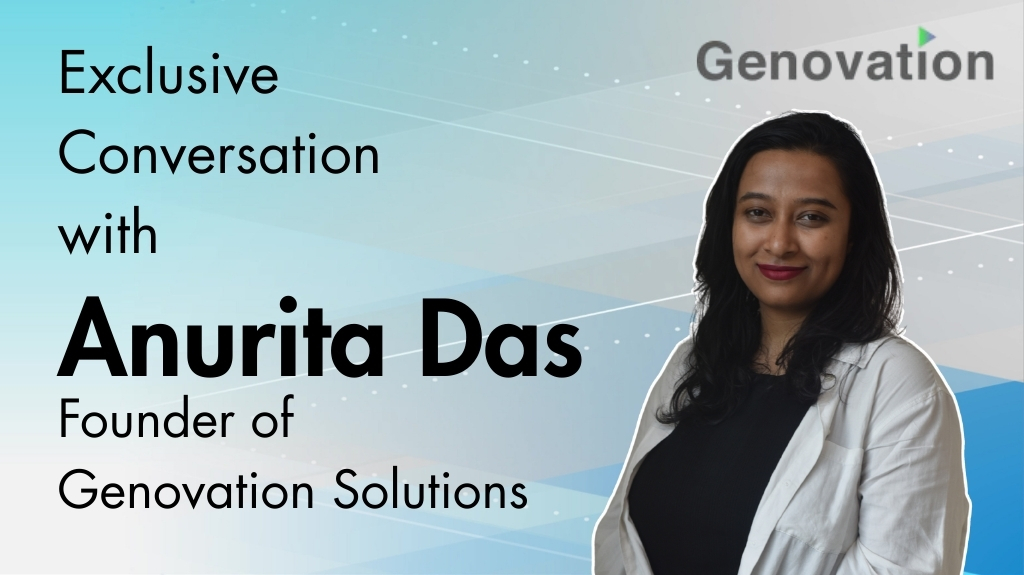
Exclusive Conversation with Anurita Das, Founder of Genovation Solutions, shares her journey into AI, the inspiration behind founding Genovation, and how their flagship product Mentis is revolutionizing enterprise AI with cost-effective, explainable, and privacy-driven solutions.
IT Voice- Tell us about your journey and what inspired you to start Genovation Solutions.
Anurita Das- I’ve been fortunate to have early exposure to AI, thanks to my experience working with one of the largest aerospace organizations in the world. There, I had the opportunity to work on research in object detection, but over time, I became particularly intrigued by Natural Language Generation (NLG), which can be seen as an early form of large language models. This fascination with AI and innovation has been with me for a long time.
The real inspiration for starting Genovation Solutions, however, came from my desire to create something unique and meaningful in India. Given my passion for AI, I wanted to build something that is cost-effective, privacy-driven and puts India at the front of the Agentic AI revolution. This led to the foundation of Genovation. I wanted to build an organization that is inclusive, forward-thinking, and driven by the pursuit of knowledge and innovation.
IT Voice- How is Genovation revolutionizing the AI industry and how are you different from your competition?
Anurita Das- Genovation brings together cutting-edge research and advanced AI engineering as it engineers human-first autonomous AI systems that deliver trustworthy intelligence across high-stakes and high-complexity environments. Our hero product, Mentis is a made-in-India agentic AI solution designed with a unique approach. The platform is approximately 15x more cost-effective than commercial AI platforms like OpenAI or Claude, making it one of the first affordable enterprise-grade AI solutions developed in India. We focus on optimizing smaller models (SLMs) tailored to specific tasks.
Another key feature of Mentis is our emphasis on explainable AI. Every decision made by the system is transparent, providing clear explanations for its actions. It cites relevant sources, and when executing code, it provides the raw execution output.
IT Voice- How is Mentis fighting the typical drawbacks of cloud-based AI systems?
Anurita Das- Mentis addresses the typical drawbacks of cloud-based AI by focusing on small, task-specific models (SLMs) that can be deployed anywhere, including on-premises and in air-gapped environments. Unlike larger models, our approach ensures efficiency and adaptability for edge and sensitive applications.
We also prioritize explainable AI, offering transparency on every decision made-citing sources, showing raw execution output, and preventing destructive actions. This transparency, along with encrypted data handling, builds trust and makes Mentis ideal for enterprise adoption, even for mission-critical cases.
IT Voice- What are the steps being taken by Genovation towards ethical sourcing and privacy?
Anurita Das- Genovation ensures that all data is encrypted, particularly at rest, so LLM only pulls out the information it requires while thinking, safe-guarding sensitive information and maintaining strict privacy standards. Additionally, by supporting on-premises and air-gapped deployment options, we ensure that sensitive data never leaves the organization’s controlled environment, reducing the risks of unauthorized access.
The explainable AI module ensures that all decisions made by its systems are transparent. Users can understand the reasoning behind every action, fostering trust and accountability.
Regarding sourcing, we primarily use synthetic data to train and fine-tune our models. This approach eliminates privacy concerns, as synthetic data does not contain any real personal information, ensuring that no privacy violations occur during the training process.
IT Voice- How has AI evolved and what is the future of AI?
Anurita Das- Even though AI seems like a relatively new concept, the idea of it is actually very old. It can be traced back to the 1950s with the work of Alan Turing, who first introduced the idea of machines that could simulate human intelligence. In fact, Turing even proposed the famous Turing Test, which remains one of the fundamental concepts in evaluating machine intelligence.
Now, when we talk about generative AI-like the language models we’re seeing today with systems such as GPT-it’s important to note that this isn’t a completely new innovation either. There have been generative models before, like Natural Language Generation (NLG) and Generative Adversarial Networks (GANs), which have been in development for many years. It’s just that the scale and capabilities of today’s AI have reached a point where it’s now accessible and practical in ways it wasn’t before.
At this point, AI is being used to help us synthesize knowledge and information, enabling us to solve complex problems. However, we are still working through the challenges of privacy, safety, and bias.
As we address these challenges, we will see AI systems becoming more and more capable of making decisions on their own. This will likely shift the roles of people who will no longer just be carrying out tasks, but will increasingly be focused on strategic problem-solving-figuring out what needs to be done and how to guide AI to achieve it.