

Fortinet Threat Landscape Report Reveals an Evolution of Malware to Exploit Cryptocurrencies
Fighting Evolving CybercrimeRequires Integrated Security
Report Methodology
You might be interested in





 Fortinet, a global leader in broad, integrated and automated cybersecurity solutions, today announced the findings of its latest Global Threat Landscape Report. The research reveals cybercriminals are evolving their attack methods to increase their success rates and to accelerate infections. While ransomware continues to impact organizations in destructive ways, there are indications that some cybercriminals now prefer hijacking systems and using them for cryptomining rather than holding them for ransom.For a detailed view of the findings and some important takeaways for CISOs read theblog. Highlights of the report follow:
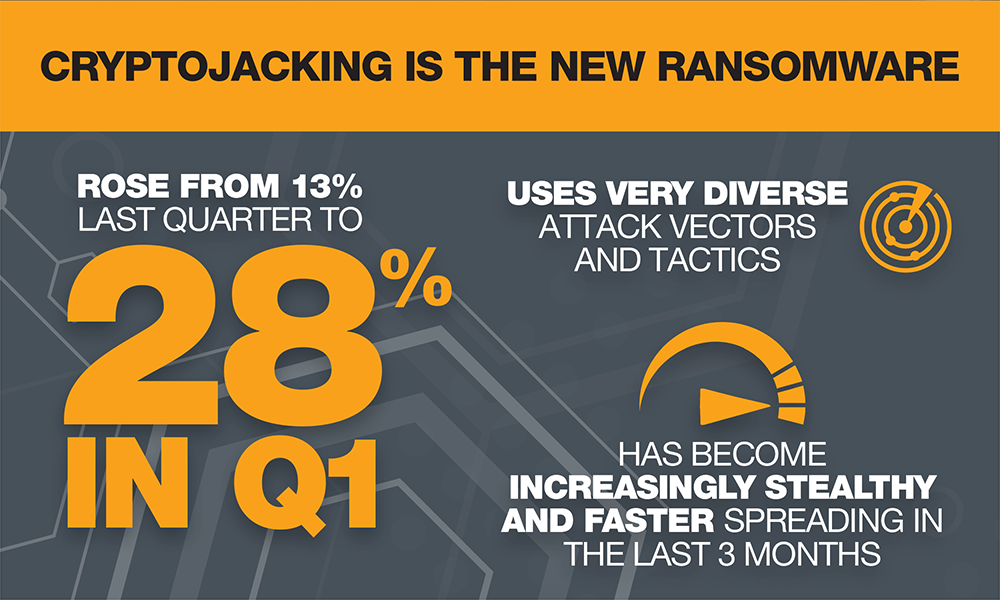 CybercrimeAttack Methods Evolve to Ensure Success at Speed and Scale Data indicates that cybercriminals are getting better and more sophisticated in their use of malware and leveraging newly announced zero-day vulnerabilities to attack at speed and scale.While the number of exploit detections per firm dropped by 13% in Q1 of 2018, the number of unique exploit detections grew by over 11%, and73% of companies experienced a severe exploit.•Spike in Cryptojacking: Malware is evolving and becoming more difficult to prevent and detect. The prevalence of cryptomining malware more than doubled from quarter to quarter, growing from 13% to 28%. Additionally, cryptojacking wasquite prevalent in the Middle East, Latin America, and Africa.Cryptomining malware is also showing incredible diversity for such a relatively new threat. Cybercriminals are creating stealthier fileless malware to inject infected code into browsers with less detection. Miners are also targeting multiple operating systems as well as different cryptocurrencies, including Bitcoin, Dash, and Monero. They are also fine-tuning and adopting delivery and propagation techniques from other threats based on what was successful or unsuccessful to improve future success rates.
 •Targeted Attacks for Maximum Impact:The impact of destructive malware remains high, particularly as criminals combine it with designer attacks. For these types of more targeted attacks, criminals conduct significant reconnaissance on an organization before launching an attack, which helps them to increase success rates. Afterwards, once they penetrate the network, attackers spread laterally across the network before triggering the most destructive part of their planned attack. The Olympic Destroyer malware and the more recentSamSam ransomwareare examples of where cybercriminals combined a designer attack with a destructive payload for maximum impact.
 •Ransomware Continues to Disrupt: The growth in both the volume and sophistication of ransomware continues to be a significant security challenge for organizations. Ransomware continues to evolve, leveraging new delivery channels such as social engineering, and new techniques such as multi-stage attacks to evade detection and infect systems. GandCrab ransomware emerged in January with the distinction of being the first ransomware to require Dashcryptocurrency as a payment. BlackRuby and SamSam were two other ransomware variants that emerged as major threats during the first quarter of 2018.
